What Our SEO Tool Found on Our Own Chat Platform
We ran BACKR, our free SEO audit tool, on chats-llm.com: 198 pages, 122 findings — and 11 that turned out to be the tool's fault, not the site's.
11 de septiembre de 2026
SEO
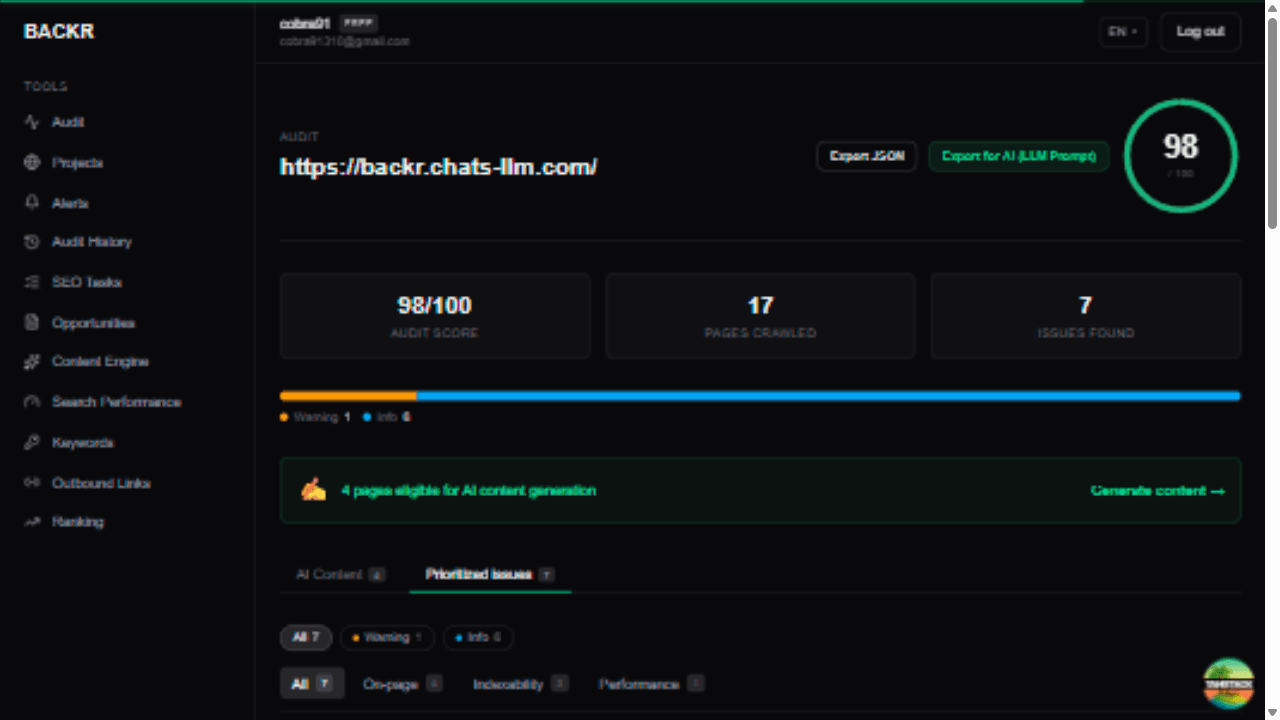
A little over a week ago we ran a technical SEO audit of our own AI chat gateway using our own SEO tool. The tool is BACKR (backr.dev), a free technical audit tool. The site was chats-llm.com, a chat platform where people can pick from 300+ models. We build both products. This is what the audit turned up, including the moment our own tool told us we were wrong.
The two products
Chats LLM is an AI chat platform. It lets people talk to GPT, Claude, Gemini, Llama, DeepSeek, and other models without signing up. It has a BYOK option, a free tier, an image studio, and a full-stack in-browser IDE.
BACKR is a free technical SEO tool. It runs 13 checkers, measures Core Web Vitals through Lighthouse, and includes a checker for AI visibility (llms.txt, AI-crawler robots rules, structured-data coverage). It also does AI content generation on a self-hosted GPU and tracks daily rank. We build it.
So when we wanted to see how our own site held up, the obvious move was to run BACKR on chats-llm.com. That's what this post is about.
What the audit found
The audit scored chats-llm.com at 84/100. It crawled 198 pages and produced 122 findings total. Not everything was worth a headline.
The biggest single issue was systematic. 78 blog post titles were longer than 60 characters. These weren't random. They were our model-release posts, and they all followed the same template. So this was a template problem, not 78 separate mistakes. A fix is rolling out.
Then there were the findings that weren't really findings. 16 pages had noindex by design. Those are the app pages: chat, studio, IDE, companion. They sit behind login and should not be indexed. The tool reported them correctly; we simply didn't want them in the index. That's a by-design state, not a bug.
A smaller set of pages came back as thin content, under about 500 words. That's worth watching as we publish more.
Where BACKR was wrong
Here's the part I want to be straight about. Eleven findings turned out to be false positives. BACKR's known-types list didn't include Blog, AboutPage, ContactPage, and CollectionPage. Those are all valid schema.org types. We were using the correct schema, and BACKR flagged it because its list was incomplete.
So the tool was wrong, not the site. And that's exactly what we wanted to catch. A few weeks earlier, running BACKR on its own site had already surfaced three bugs in BACKR, including a JSON-LD extraction bug that had been silent since launch. That earlier loop pushed BACKR's own score from 92 to 98 — we wrote it up at backr.dev/en/case-study. So this time around we expected some of our own findings to be our own fault. Eleven of them were.
That's the whole point of dogfooding. A tool that never complains about itself looks exactly like a clean site.
What we're doing about it
On the site side: fixing the model-release template so titles stay under 60 characters, and keeping an eye on the thin pages as we publish more.
On the tool side: those 11 findings led to a fix in BACKR itself the same week. Four more valid schema.org types are now recognized, and every real site we audit keeps teaching the checker its own gaps. We'd rather the tool be wrong in public than wrong in production.
The lesson
An audit is only as good as its extractor. The score, the pages crawled, the finding count, they're all useful. But the number at the top of the report is not the point. What matters is whether the tool can catch its own mistakes.
Dogfooding your own tool catches what CI cannot. CI checks the code. It doesn't check whether the tool's own assumptions are complete. That's why running BACKR on its own site mattered: it found real bugs, including one that had been silent since launch.
If you build a tool, point it at yourself before anyone else does. You'll find the boring findings, the by-design states, and the one place where the tool itself is wrong. All three are useful. The last one is the one you'd miss otherwise.
Try it
BACKR is a free technical SEO audit tool at backr.dev. No signup required. It runs 13 checkers, measures Core Web Vitals through Lighthouse, and checks AI visibility through llms.txt, AI-crawler robots rules, and structured-data coverage.
If you want the full story of how running it on our own site caught real bugs and moved BACKR’s score from 92 to 98, it’s at https://backr.dev/en/case-study. And the site we audited, chats-llm.com, is the AI chat gateway we build.
Run it on your own site. See what you’ve been missing.