Model Releases
Xiaomi's MiMo-V2.6: The New Open-Source King of Omnimodal AI
Xiaomi disrupts the AI landscape with MiMo-V2.6, a 1T-parameter sparse MoE model that rivals GPT-5.6 and Claude Opus 5 in agentic reasoning.
21 de septiembre de 2026
Model ReleaseMiMo-V2.6
The Dawn of a New Era in Open-Weight AI
On September 21, 2026, the AI industry witnessed a seismic shift. Xiaomi has officially released MiMo-V2.6, a milestone multimodal model series that fundamentally challenges the dominance of closed-source giants. This isn't just another incremental update; it is a historical moment for the open-source community, proving that high-parameter, high-reasoning models can be democratized through efficient architecture and scaled reinforcement learning.
The release introduces two distinct models: MiMo-V2.6 Pro, designed for heavy-duty reasoning and complex agentic tasks, and MiMo-V2.6 Flash, optimized for high-throughput, low-latency applications. By open-sourcing the model weights, technical reports, RL environments, and training code, Xiaomi is providing developers with the ultimate toolkit to build the next generation of autonomous agents.
- Release Date: September 21, 2026
- Models: MiMo-V2.6 Pro & MiMo-V2.6 Flash
- License: Open Source (Weights and Training Code)
- Significance: Highest score on Artificial Analysis Intelligence Index for open models
Architecture: Sparse MoE and Scaled RL
At the heart of MiMo-V2.6 Pro lies a massive Sparse Mixture-of-Experts (MoE) architecture. The model boasts a total of 1.02 trillion parameters, but thanks to its sparse design, only 42 billion parameters are activated per token. This allows for the intelligence of a trillion-parameter model with the computational efficiency required for practical deployment.
The true breakthrough, however, is the training methodology. Xiaomi introduced 'You Only RL Once' (YORLO), a unified mixed reinforcement learning run that spans coding, general agents, visual reasoning, and cybersecurity. This is complemented by Groupwise Agentic Grading (GRS + GAR), which creates a self-improvement loop by scaling the reward signal through agentic feedback. For tasks that are difficult to verify objectively, the team implemented Multi-Prefix Multi-Teacher On-Policy Distillation (MOPD2), ensuring high performance even in subjective or complex reasoning domains.
- Total Parameters: 1.02T
- Activated Parameters: 42B (Sparse MoE)
- Context Window: 1 Million Tokens
- Modality: Omnimodal (Text, Image, Video, Audio)
- Training Innovation: 'You Only RL Once' (YORLO) and MOPD2
Benchmarks: Outperforming the Giants
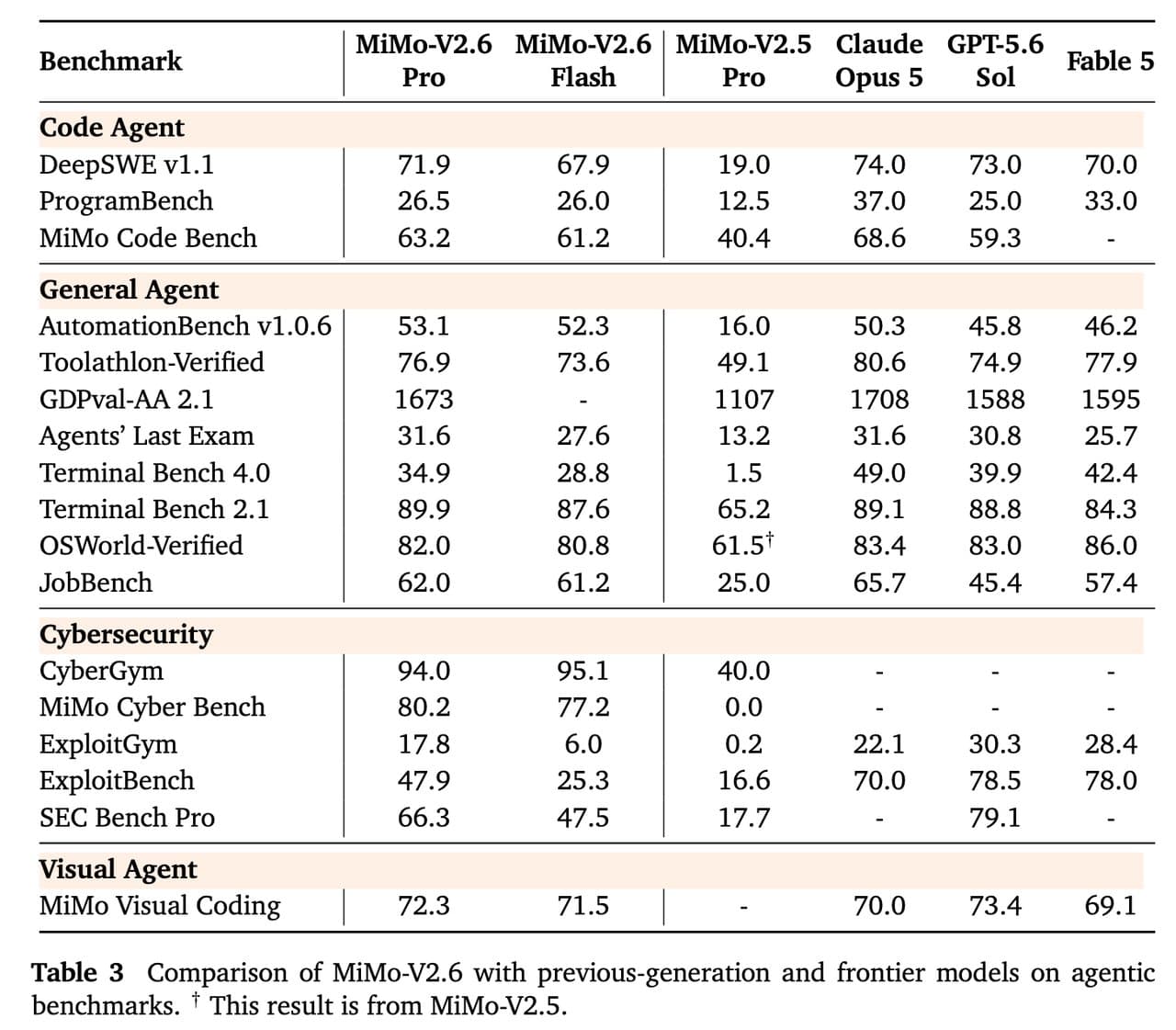
The numbers speak for themselves. MiMo-V2.6 Pro has achieved a score of 46 on the Artificial Analysis Intelligence Index, the highest ever recorded for an open-source model. In head-to-head comparisons, the Pro version performs on par with industry leaders like Claude Opus 5 and GPT-5.6 Sol across critical agentic benchmarks.