Model Releases
The Era of Agentic Intelligence: Deep Diving into Anthropic's Claude Opus 5
Anthropic's Claude Opus 5 marks a historical milestone in LLM evolution, delivering frontier reasoning and massive 1M context windows at half the cost of competitors.
July 24, 2026
Model ReleaseClaude Opus 5
Introduction: A Milestone in AI Evolution
On July 24, 2026, Anthropic officially released Claude Opus 5, a model that doesn't just iterate on its predecessors but fundamentally shifts the paradigm of what we expect from large language models. For developers and AI engineers, this release represents the transition from 'chatbots' to 'autonomous agents.'
While previous generations focused on conversational fluency, Opus 5 is engineered for deep reasoning and long-horizon task execution. It arrives at a critical moment in the industry, offering a direct challenge to frontier models like Fable 5 by providing near-equivalent intelligence with significantly better cost-efficiency and specialized agentic capabilities.
- Release Date: July 24, 2026
- Primary Focus: Deep reasoning and agentic autonomy
- Historical Significance: The first model to bridge the gap between frontier intelligence and enterprise-scale cost-efficiency
Key Features & Architecture
Claude Opus 5 introduces a massive architectural leap, most notably through its unified context management. Unlike previous models that offered varying context lengths, Opus 5 ships with a standardized 1M token context window for both default and maximum settings. This ensures predictable performance for RAG pipelines and massive codebase ingestion.
A standout feature is the 'Thinking' capability, which is now enabled by default. This allows the model to utilize test-time compute scaling, effectively 'thinking' through complex problems before delivering a final response. Additionally, the model supports a massive 128k maximum output token limit, enabling the generation of entire technical documents or complex codebases in a single pass.
- Context Window: 1M tokens (standardized)
- Max Output: 128k tokens
- Thinking Mode: Enabled by default for enhanced reasoning
- Prompt Caching: Minimum threshold lowered to 512 tokens
- Multimodal: Advanced vision for UI replication and diagram analysis
Performance & Benchmarks: Outperforming the Frontier
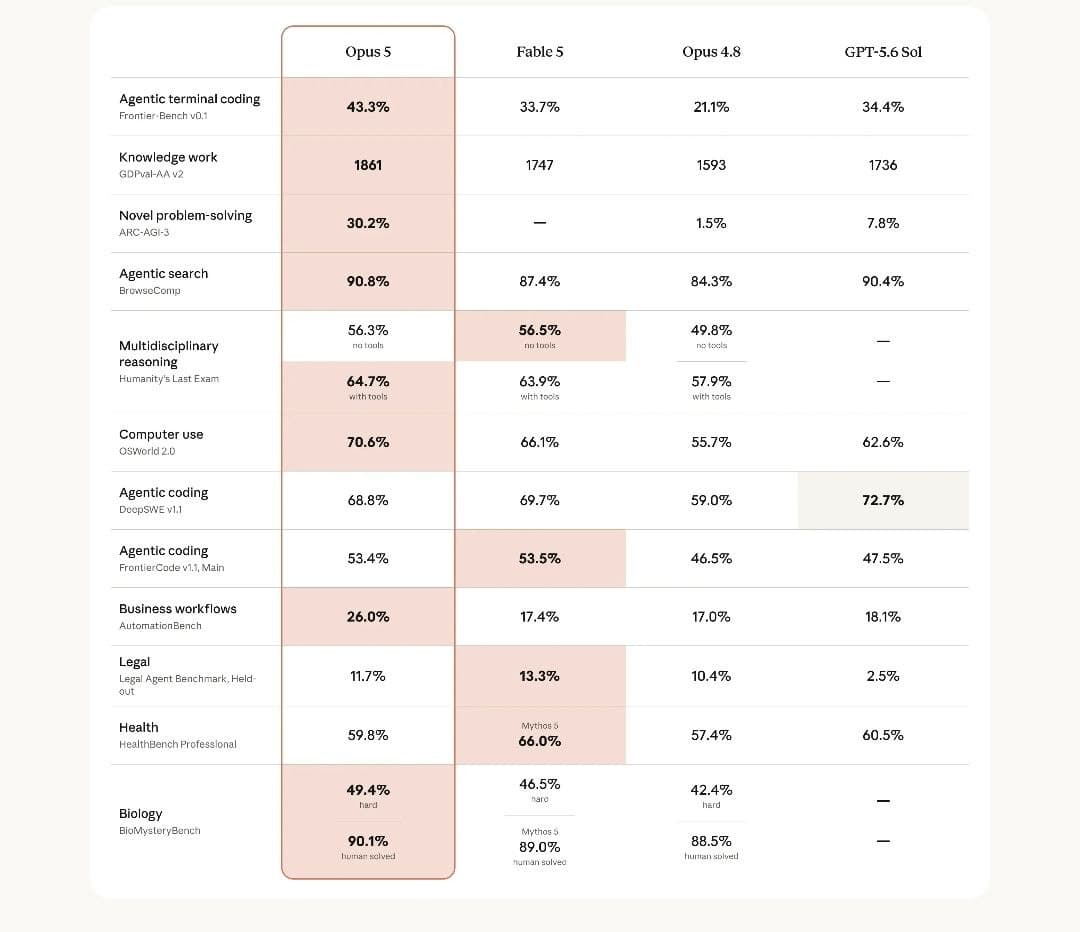
The performance gains over Claude Opus 4.8 are substantial, particularly in domains requiring multi-step logic. In coding benchmarks like SWE-bench, Opus 5 demonstrates a superior ability to complete multi-file features and large-scale refactors without leaving stubs or placeholders—a common failure point in earlier models.
In comparative testing against Fable 5, Opus 5 outscores its competitor on most major reasoning and coding benchmarks. Its ability to perform high-accuracy code reviews with minimal false positives makes it a preferred tool for automated CI/CD pipelines. Furthermore, its vision capabilities allow it to replicate frontend visuals and interpret complex charts with unprecedented precision.