Model Releases
Claude Sonnet 5.5: The New Gold Standard for Agentic Coding and Efficiency
Anthropic's Claude Sonnet 5.5 delivers flagship-level coding intelligence and agentic capabilities at half the cost of Opus 5.5.
September 28, 2026
Model ReleaseClaude Sonnet 5.5
Introduction: A Paradigm Shift in Mid-Tier Models
On September 28, 2026, Anthropic officially released Claude Sonnet 5.5, a model that fundamentally redefines the expectations for 'mid-tier' AI. While the industry has long categorized models into 'flagship' and 'efficient' tiers, Sonnet 5.5 blurs these lines by delivering performance that rivals the top-tier Opus 5.5 in critical developer workflows, specifically in agentic coding and complex reasoning.
For developers and AI engineers, this isn't just another incremental update. It is a specialized tool designed to handle the heavy lifting of everyday software engineering—bug fixing, document generation, and complex spreadsheet manipulation—while maintaining a speed and cost profile that makes large-scale agentic workflows economically viable for the first time.
- Released: September 28, 2026
- Category: Coding & Agentic Intelligence
- Primary Focus: Speed, cost-efficiency, and autonomous coding tasks
Key Features & Architecture
Claude Sonnet 5.5 is engineered for high-throughput environments. It boasts a massive 1M token context window and a 128K maximum output limit, allowing it to ingest entire codebases or massive technical documentation sets without losing coherence. It is also the fastest Sonnet model to date, generating outputs 30% faster than its predecessor, Sonnet 5.
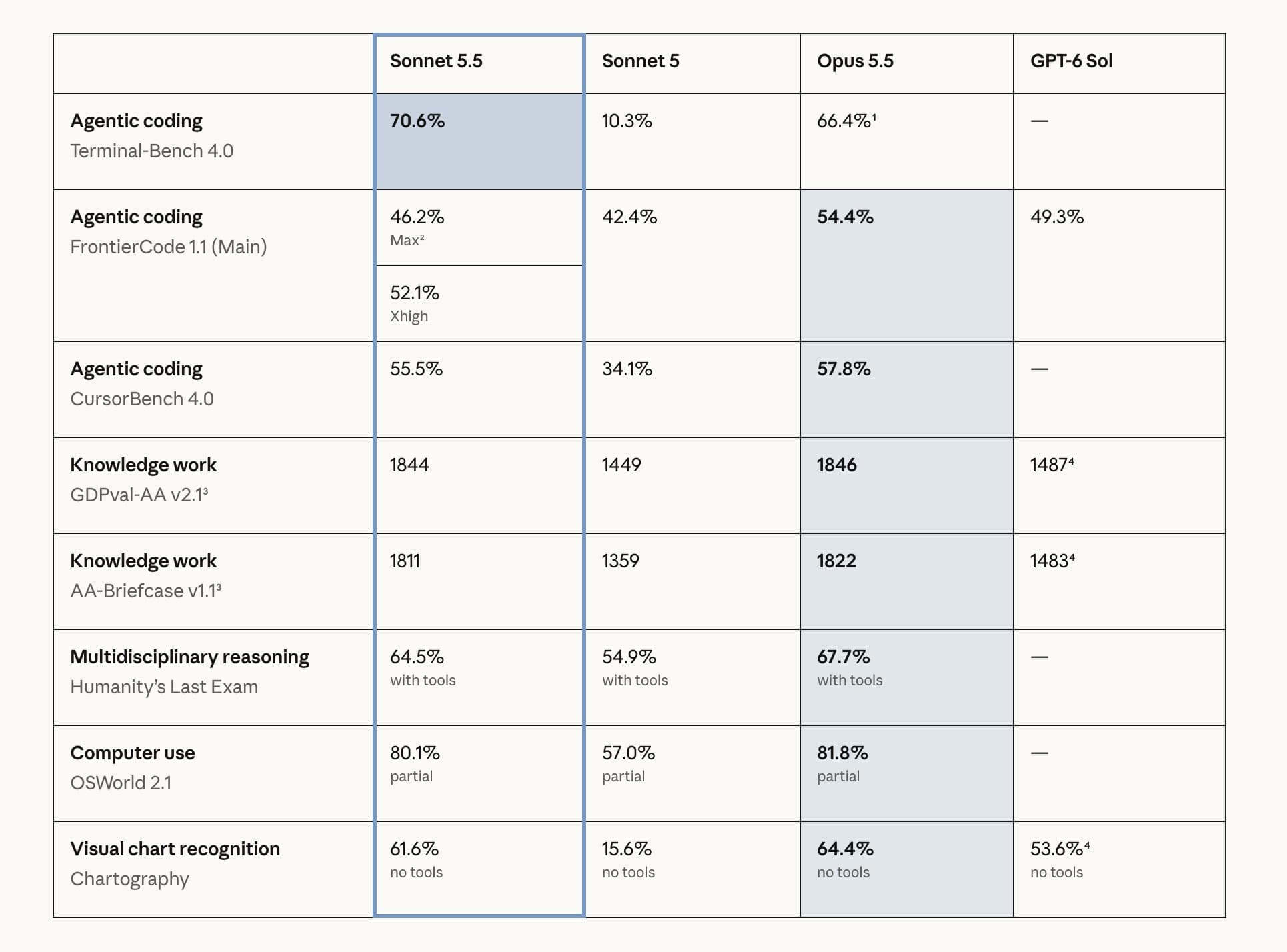
A standout architectural achievement is its multimodal capability. Sonnet 5.5 demonstrates unprecedented visual reasoning, evidenced by its ability to beat Pokémon Red playing solely from screenshots—a feat never before achieved by a Sonnet-class model. Furthermore, its Chartography capabilities for visual chart recognition have jumped from 15.6% in Sonnet 5 to a staggering 61.6%, outperforming even GPT-6 Sol in this specific domain.
- Context Window: 1,000,000 tokens
- Max Output: 128,000 tokens
- Speed: 30%+ faster than Sonnet 5
- Multimodal: Advanced screenshot-based reasoning and Chartography
Performance & Benchmarks: Beating the Flagship
The most shocking revelation in the Sonnet 5.5 release is its performance on agentic coding benchmarks. On Terminal-Bench 4.0, Sonnet 5.5 scored 70.6%, a massive leap from Sonnet 5's 10.3%. Remarkably, this score actually surpasses the flagship Opus 5.5, which scored 66.4%. This suggests that Sonnet 5.5 is specifically optimized for the iterative, tool-using nature of modern AI agents.
In other rigorous testing environments, the model remains highly competitive. On FrontierCode 1.1 (Max effort), it achieved 46.2%, trailing only Opus 5.5 (54.4%) and GPT-6 Sol (52.1%). On CursorBench 4.0, it hit 55.5%, significantly outperforming Sonnet 5's 34.1%. Its reasoning capabilities are also near-flagship, with a GDPval-AA v2.1 score of 1844, just two points shy of Opus 5.5.