Model Releases
Liquid AI Releases d1.2 and d1.2-ultra Omnimodal Decision Models
Liquid AI marks a milestone in non-generative AI with the d1.2 series, delivering unprecedented decision accuracy and multimodal audio-visual reasoning.
November 16, 2026
Model Released1.2
Introduction
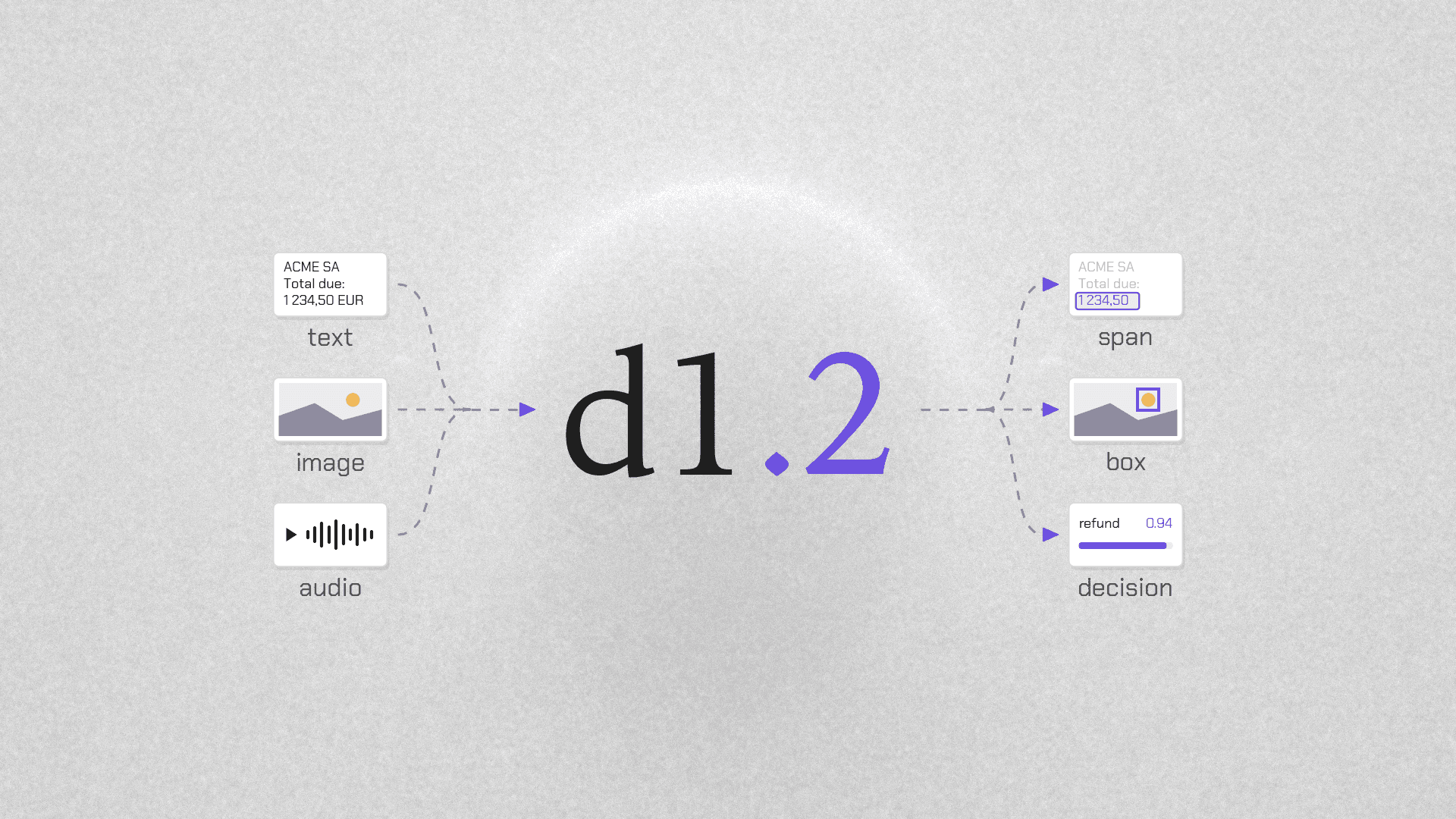
On November 16, 2026, Liquid AI shifted the paradigm of machine intelligence with the release of d1.2 and d1.2-ultra. While the industry has been locked in a generative arms race focused on long-form text production, Liquid AI has taken a different, more surgical approach: the decision model. Unlike traditional LLMs that predict the next token, the d1.2 series is designed to return probability-based decisions on closed questions, providing a level of precision and reliability previously unseen in frontier models.
This release represents a historical milestone for the 'decision model' class of AI. By moving away from the stochastic nature of text generation and toward deterministic, high-confidence decision outputs, Liquid AI is providing the missing link for autonomous agents and industrial-grade automation. The d1.2 series doesn't just 'chat' about a problem; it solves it with mathematical certainty.
- Category: Omnimodal Decision Models
- Core Functionality: Probability-based decision output (non-generative)
- Key Innovation: High-precision multimodal reasoning (Text, Image, Audio)
Key Features & Architecture
The d1.2 architecture is built to handle complex, multi-step reasoning across diverse input modalities. A standout feature of this generation is the integration of native audio input capabilities. Both d1.2 and d1.2-ultra can process raw audio to identify sounds or transcribe and classify spoken languages with extreme accuracy. This makes them uniquely suited for real-world sensory integration tasks.
The models also introduce five specialized API tasks designed for high-stakes data extraction and spatial reasoning. These tasks move beyond simple prompting, allowing developers to interact with the model for structured data retrieval, object localization, and numerical estimation. Furthermore, the models are engineered with a 'refusal mechanism' to prevent hallucinations; if the input does not contain the necessary information to answer a question, the model refuses to guess, a critical requirement for enterprise reliability.
- Multimodal Support: Text, Images, and Audio (ESC-50 and FLEURS benchmarks)
- Specialized Tasks: Document value extraction, PII detection, object localization, and range estimation
- Hallucination Mitigation: Strict refusal policy for insufficient input data
- Efficient Image Processing: 1.5 tokens per 32x32-pixel patch
Performance & Benchmarks
The performance metrics for d1.2-ultra are nothing short of industry-leading. On the Artificial Analysis Decision Index v2.1, d1.2-ultra scored a 75, making it the first model to break the 70-point barrier and placing it two points ahead of its nearest competitor. Perhaps more importantly, d1.2-ultra represents the pinnacle of the index; no other model currently scores higher at any price point.