Model Releases
The Dawn of Long-Horizon Reasoning: Deep Diving into Google's Gemini 4 Argon
Google's Gemini 4 Argon marks a paradigm shift in AI, delivering massive 1M token output windows and SOTA performance in software engineering and cybersecurity.
September 30, 2026
Model ReleaseGemini 4 Argon
Introduction: A Milestone in Artificial Intelligence
On September 30, 2026, Google officially unveiled Gemini 4 Argon, a frontier reasoning model that represents a fundamental shift in how LLMs approach complex, multi-step tasks. Unlike previous generations that focused on short-burst chat interactions, Argon is architected to sustain deep reasoning across long-horizon workflows, making it a true 'agentic' powerhouse.
This isn't just another incremental update. Argon is a milestone model designed to solve problems that were previously considered computationally insurmountable for AI. By prioritizing high-effort compute and sustained logical consistency, Google is positioning Argon as the backbone for the next generation of autonomous professional agents.
- Released: September 30, 2026
- Primary Focus: Long-horizon reasoning and autonomous agency
- Initial Deployment: Rolling out via the Fairwind Program to trusted cyber defenders
Architecture and Unprecedented Context Capabilities
The most striking technical achievement of Gemini 4 Argon is its industry-leading output limit. While the previous standard hovered around 64K tokens, Argon can generate up to 1 million tokens in a single response. This 15x increase provides the necessary headroom to rewrite entire massive codebases or draft exhaustive legal documents in a single inference pass.
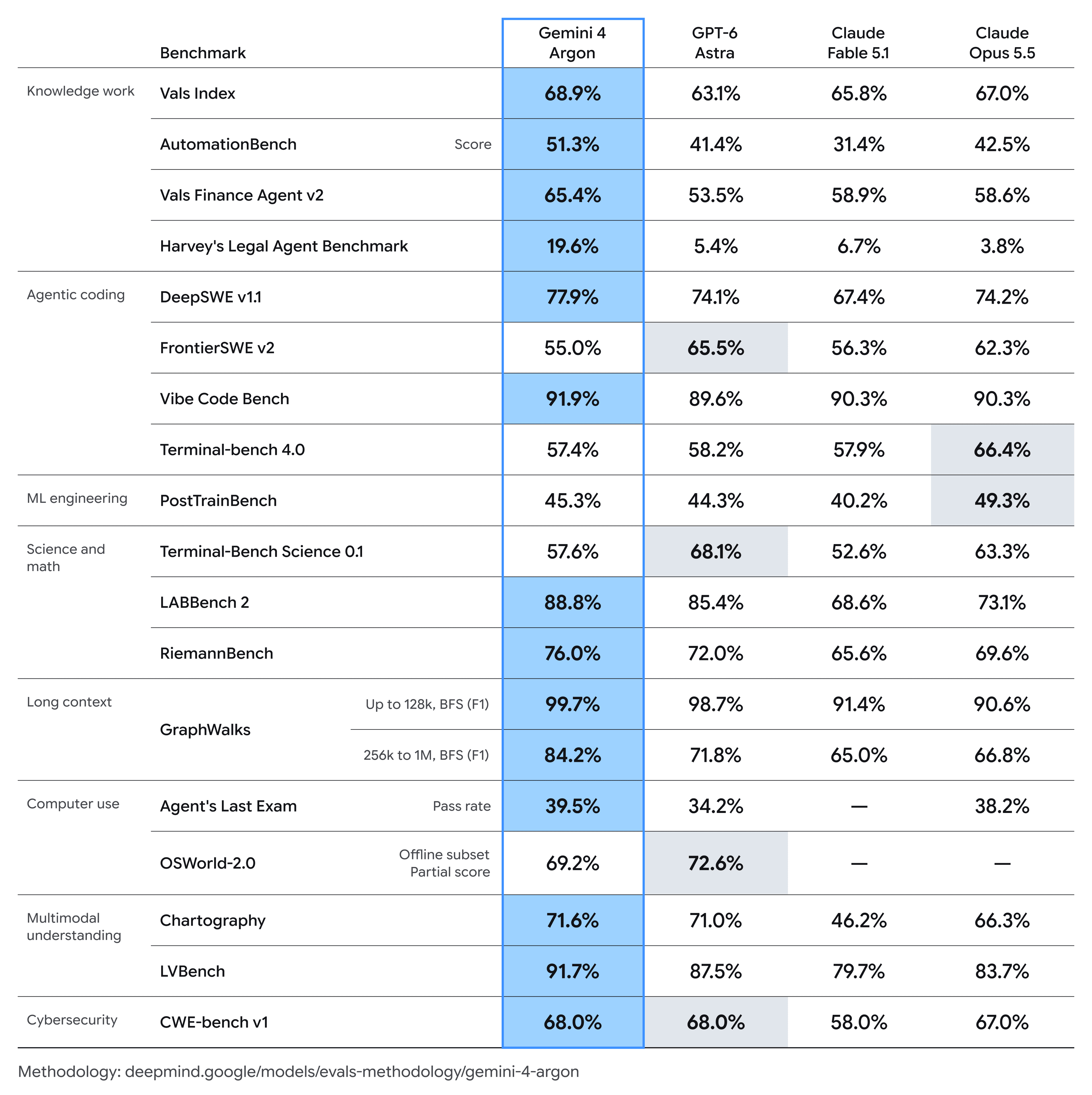
Argon also demonstrates elite multimodal reasoning. On the LVBench long video understanding benchmark, it achieved a state-of-the-art score of 91.7%. This capability extends to professional-grade document analysis and complex chart interpretation, allowing the model to act as a visual reasoning engine for data scientists and analysts.
- Output Limit: Up to 1M tokens per single response
- Video Understanding: 91.7% on LVBench (SOTA)
- Multimodal Strengths: Professional chart analysis and document-based action
Benchmark Dominance: Software Engineering and Economics
Argon is setting new records across the most demanding technical benchmarks. In real-world, long-horizon software engineering, it achieved a massive 77.9% on DeepSWE v1.1. This capability was demonstrated in practical applications, such as migrating the Fuchsia OS Zircon kernel from C/C++ to Rust—a massive undertaking involving over 800,000 lines of code.
Beyond coding, Argon leads the Vals Index, which measures economic impact across finance, legal, and tax sectors. It holds the #1 spot on AutomationBench with a score of 51.3% and shows incredible performance on specialized benchmarks like Vals Finance Agent v2 and Harvey's Legal Agent Benchmark.