Model Releases
Google Releases Gemini 4 Carbon Frontier Language Model
Google unveils Gemini 4 Carbon, a milestone model optimized for long-horizon engineering and state-of-the-art cybersecurity defense.
October 28, 2026
Model ReleaseGemini 4 Carbon
Introduction
On October 28, 2026, Google announced the release of Gemini 4 Carbon, marking a significant milestone in the evolution of frontier artificial intelligence. Arriving just two weeks after the Gemini 4 Argon release, Carbon is not merely an incremental update but a specialized powerhouse designed to tackle the most grueling challenges in software engineering and cybersecurity.
While Argon focused on general reasoning and speed, Carbon has been architected for depth. It represents a shift in the industry from models that simply 'answer questions' to models that 'perform work.' By focusing on long-horizon tasks and defensive security, Google is positioning Carbon as the primary engine for autonomous engineering agents and enterprise-grade security operations.
- Release Date: October 28, 2026
- Primary Focus: Cybersecurity, long-horizon engineering, and complex patching
- Status: Milestone frontier model
Key Features & Architecture
Gemini 4 Carbon is built on a highly optimized architecture designed to maintain coherence over extremely long execution traces. Unlike standard LLMs that struggle with 'drift' during multi-step reasoning, Carbon is trained specifically for long-horizon engineering. This allows internal Google teams to run the model for days at a time, enabling it to root-cause and patch subtle bugs across massive, distributed codebases and low-level systems.
The model demonstrates a massive leap in reliability and safety. It features a significantly reduced rate of unsupported claims and overreach compared to its predecessor, Argon. This makes it a viable candidate for autonomous agents that require high precision in multi-step plan execution without constant human intervention.
- Long-horizon reasoning: Capable of multi-day autonomous debugging tasks
- Enhanced reliability: 2x reduction in unsupported claims vs Argon
- Reduced overreach: 26% improvement in plan execution accuracy
- Improved service: 29% reduction in under-service during complex tasks
Performance & Benchmarks
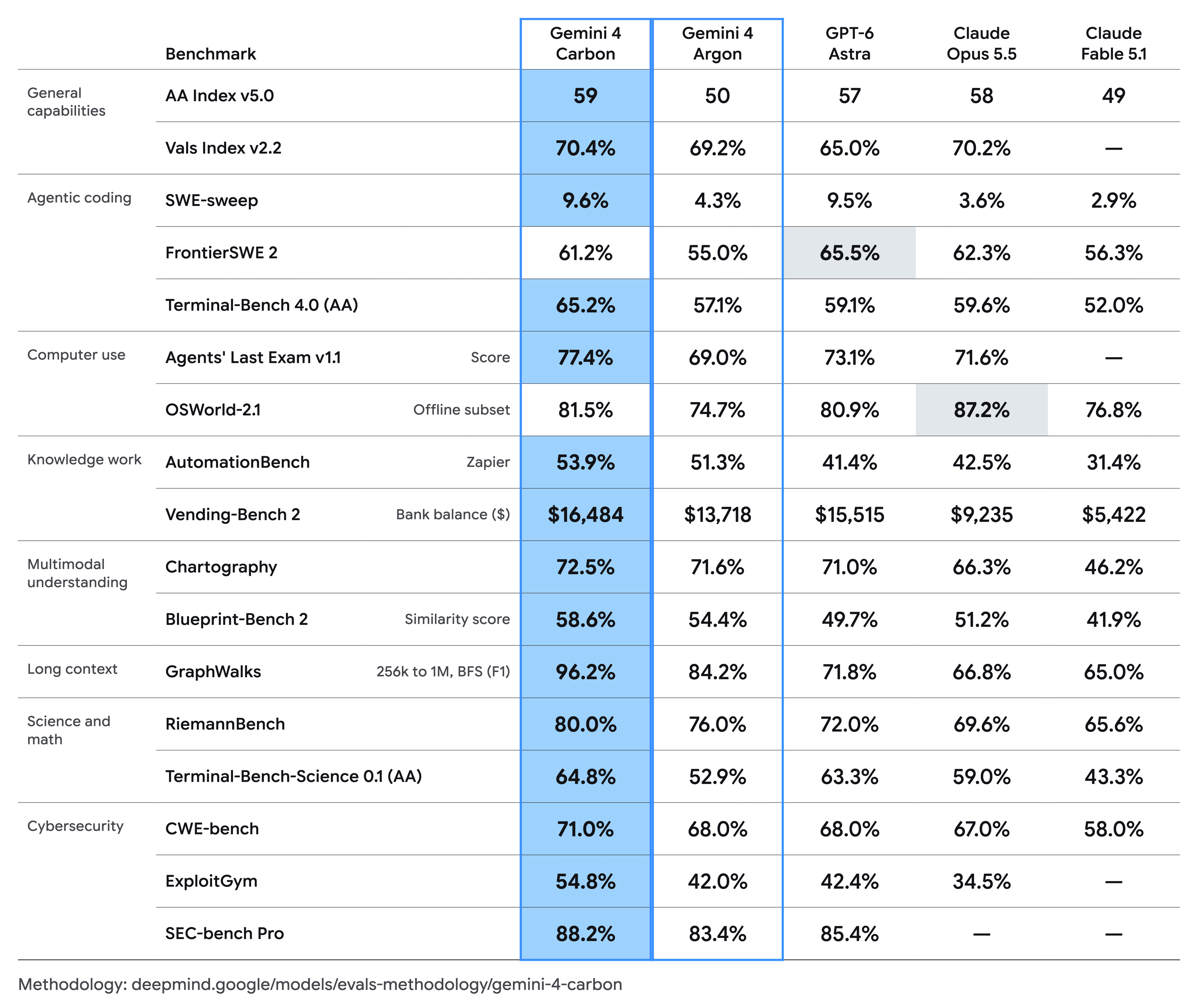
The performance metrics for Gemini 4 Carbon are historic. The model currently ranks #1 on the Artificial Analysis Intelligence Index v5.0 with a score of 59. In the domain of cybersecurity, Carbon sets a new industry standard. It achieved 88.2% on SEC-bench Pro for vulnerability detection and 71.0% on CWE-bench for automated patching. Notably, the Chrome team reported that Carbon-generated patches were rated over 10x better than those produced by other leading frontier models.