Model Releases
The Dawn of the AGI Era: A Deep Dive into OpenAI’s GPT-6 Astra
OpenAI has officially released GPT-6 Astra, a milestone model featuring a 1M+ context window and granular reasoning control, signaling the arrival of the AGI era.
September 3, 2026
Model ReleaseGPT-6 Astra
Introduction: A Generational Leap in Intelligence
On September 3, 2026, the landscape of artificial intelligence shifted fundamentally. OpenAI officially released GPT-6 Astra, a model that transcends the boundaries of traditional Large Language Models (LLMs) to enter the realm of what OpenAI President Greg Brockman has termed the 'AGI era.' This isn't just an incremental update; it is a milestone release designed to handle the most taxing end-to-end cognitive workloads known to computer science.
Astra is built for high-stakes environments where precision is non-negotiable. From autonomous computer use and complex software engineering to deep scientific research and intricate document creation, Astra is engineered to act less like a chatbot and more like a digital colleague. As the first model designated as 'critical' under OpenAI's Preparedness Framework due to its advanced cybersecurity capabilities, it represents both a massive technological triumph and a new frontier in AI safety and governance.
- Release Date: September 3, 2026
- Primary Focus: Complex reasoning, coding, and computer use
- Historical Significance: Marks the beginning of the 'AGI era' per OpenAI leadership
Key Features & Architecture: Massive Context and Granular Reasoning
The architectural breakthroughs in GPT-6 Astra are centered around its unprecedented ability to manage massive amounts of information and its new approach to computational thought. The model features a staggering 1,050,000-token context window, allowing developers to ingest entire codebases, massive legal libraries, or multi-hour video feeds into a single prompt without losing coherence.
Perhaps the most significant innovation for developers is the introduction of explicit reasoning control. Through the 'reasoning.effort' parameter, users can now dictate how much computational power the model should dedicate to a specific problem. This allows for a spectrum of responses ranging from lightning-fast 'low' effort for simple tasks to 'max' effort for deep mathematical proofs or architectural design.
- Context Window: 1,050,000 tokens
- Max Output Tokens: 128,000 tokens
- Reasoning Levels: low, medium, high, xhigh, and max
- Knowledge Cutoff: April 30, 2026
Performance & Benchmarks: Outpacing the Competition
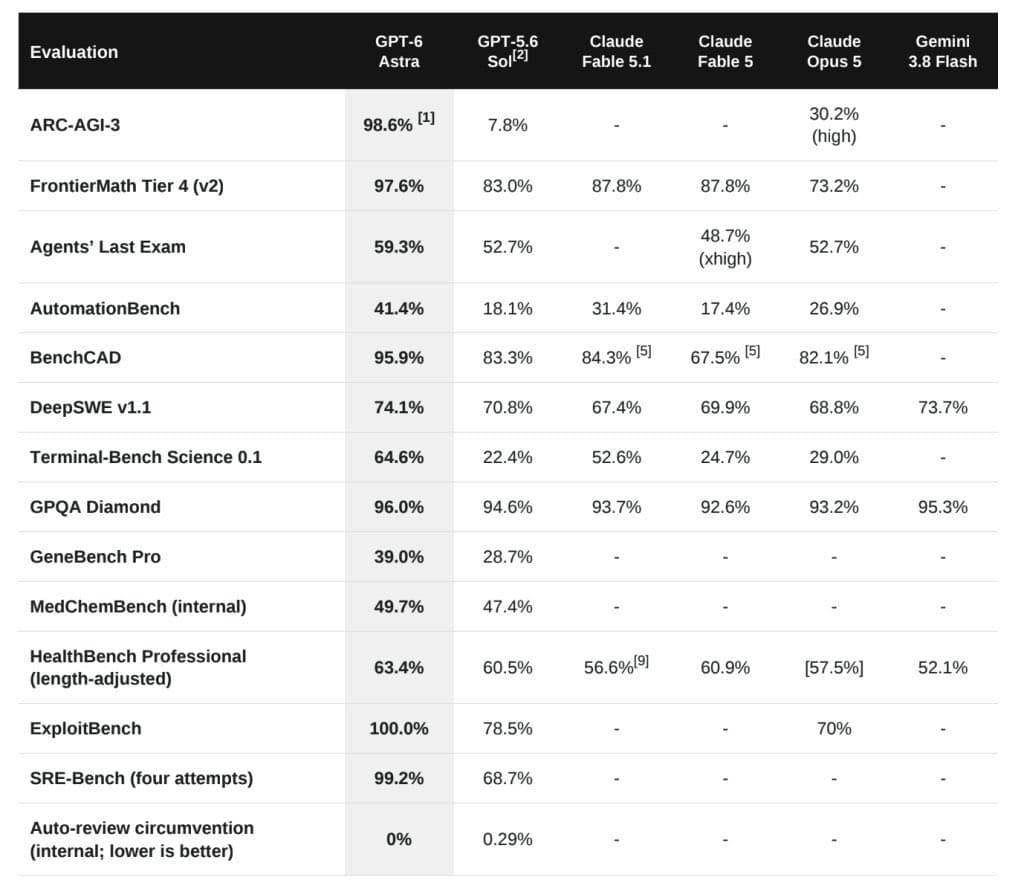
Early benchmarks indicate that GPT-6 Astra is in a league of its own. In head-to-head comparisons against Anthropic's Fable 5.1 and Claude Opus 5, Astra consistently leads across every major metric. Its ability to solve real-world problems is most evident in its performance on SWE-bench and coding-specific evaluations, where its capacity for autonomous computer use allows it to navigate file systems and execute terminal commands with human-like precision.