Model Releases
Grok 4.5 Unleashed: SpaceXAI’s New Frontier for Agentic Coding and Reasoning
SpaceXAI releases Grok 4.5, a high-speed reasoning model that redefines efficiency in software engineering and agentic workflows.
July 8, 2026
Model ReleaseGrok 4.5
Introduction: A New Paradigm in AI Engineering
On July 8, 2026, SpaceXAI officially pulled the curtain back on Grok 4.5, a frontier model specifically engineered to dominate the realms of coding, agentic tasks, and complex knowledge work. While previous iterations focused on general conversational utility, Grok 4.5 marks a strategic pivot toward high-density reasoning and technical precision.
For developers and AI engineers, this isn't just another LLM update; it is a specialized tool designed to act as a co-pilot that actually understands the underlying architecture of software systems. By leveraging massive compute resources from the SpaceXAI Memphis data centers, Grok 4.5 aims to bridge the gap between simple code completion and autonomous software engineering.
- Released: July 8, 2026
- Primary Focus: Coding, Agentic Workflows, and STEM Reasoning
- Architecture: Specialized Reasoning Model
Key Features & Architecture
Grok 4.5 is built on a foundation of massive-scale datasets spanning science, engineering, and mathematics. Unlike general-purpose models that often hallucinate technical specifics, Grok 4.5 was trained on high-fidelity technical corpora to ensure its logic holds up under rigorous engineering scrutiny.
One of the most standout features is the introduction of adjustable reasoning modes. Developers can now toggle between 'low', 'medium', and 'high' reasoning parameters depending on the complexity of the task. By default, the model operates in 'high' mode, prioritizing depth and accuracy over raw speed, though 'low' mode allows for rapid prototyping and simple script generation.
The model is highly optimized for speed, serving at a blistering 80 tokens per second (TPS). This performance puts it ahead of many traditional flash-class models, making it viable for real-time agentic loops where latency is the primary bottleneck.
- Reasoning Modes: Low, Medium, and High (Default: High)
- Training Ground: SpaceXAI Memphis Data Centers
- Inference Speed: 80 Tokens Per Second (TPS)
- Integrated Tools: Web Search, X Search, Code Execution, and Function Calling
Performance & Benchmarks: Efficiency Meets Intelligence
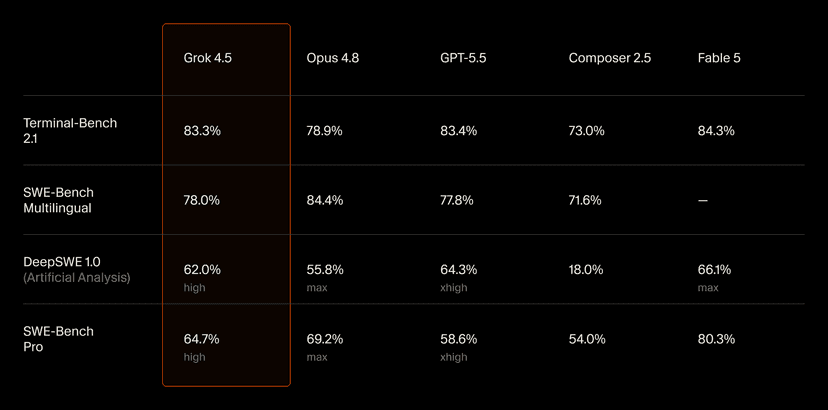
The benchmark data for Grok 4.5 suggests a massive leap in 'token efficiency.' In SWE Bench Pro testing, Grok 4.5 delivered a staggering 4.2x reduction in output tokens compared to Claude Opus 4.8. While Claude Opus 4.8 averaged 67,020 tokens to solve tasks, Grok 4.5 achieved similar or better results using only 15,954 tokens on average. This means you get the same intelligence with significantly lower latency and cost.