Model Releases
Tencent's Hy3: The Open-Source MoE Milestone That Challenges Trillion-Parameter Giants
Tencent has officially released Hy3, a massive 295B MoE model that brings frontier-level performance to the open-source community under Apache 2.0.
July 7, 2026
Model ReleaseHy3
Introduction: A New Era for Open-Source Intelligence
On July 7, 2026, the landscape of artificial intelligence shifted significantly with Tencent's release of Hy3. For years, the gap between closed-source proprietary models and open-weight alternatives has been widening, leaving developers to choose between privacy and peak performance. Hy3 changes that equation entirely.
This isn't just another incremental update; it is a milestone model. By releasing a 295B parameter powerhouse under the Apache 2.0 license, Tencent is effectively bringing the 'open frontier' within reach of every developer, enterprise, and researcher. Hy3 represents a massive leap in efficiency and capability, proving that open-source can compete with the world's most expensive closed-source ecosystems.
- Model Name: Hy3
- Provider: Tencent
- Architecture: 295B Mixture-of-Experts (MoE)
- License: Apache 2.0
- Release Date: 2026-07-07
Architecture: The Power of 295B Mixture-of-Experts
At the heart of Hy3 lies a sophisticated 295B parameter Mixture-of-Experts (MoE) architecture. Unlike dense models that activate every parameter for every token, Hy3 utilizes a sparse activation strategy. This allows the model to possess the vast knowledge base of a massive model while maintaining the inference efficiency of a much smaller one.
The development of Hy3 was not done in a vacuum. Following a highly successful preview in late April, Tencent engaged with over 50 different product teams to gather real-world feedback. This iterative process allowed them to scale up post-training using significantly higher-quality, curated datasets, resulting in a model that is both smarter and more reliable than its predecessors.
- Total Parameters: 295B
- Architecture: Sparse Mixture-of-Experts (MoE)
- Optimization: High-quality post-training based on 50+ product feedback loops
- License: Fully commercial-friendly Apache 2.0
Property Value Architecture Mixture-of-Experts (MoE) Total Parameters 295B Activated Parameters 21B MTP Layer Parameters 3.8B Number of Layers (excluding MTP layer) 80 Number of MTP Layers 1 Attention Heads 64 (GQA, 8 KV heads, head dim 128) Hidden Size 4096 Intermediate Size 13312 Context Length 256K Vocabulary Size 120832 Number of Experts 192 experts, top-8 activated Supported Precisions BF16
Performance Benchmarks: Outperforming the Competition
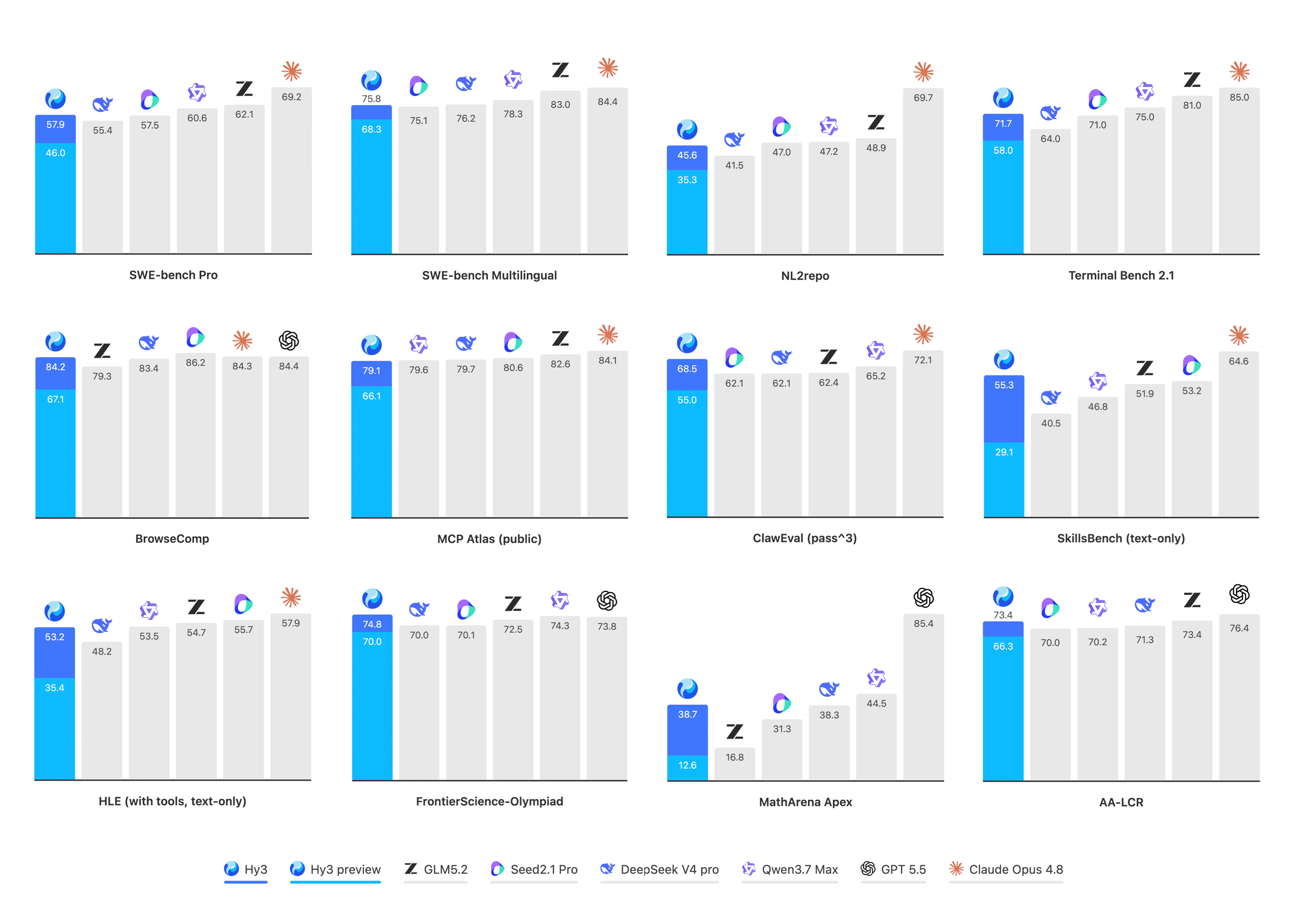
The most striking aspect of Hy3 is its performance relative to its size. While it is significantly smaller than the trillion-scale flagship models from closed labs, it rivals them in many key domains. In a blind evaluation conducted by 270 domain experts, Hy3 achieved a score of 2.67/4, notably outperforming GLM-5.1, which scored 2.51/4.