Model Releases
The Dawn of Open Intelligence: K2 Horizon by IFM Redefines the Frontier
IFM has released K2 Horizon, the largest and most transparent open-source model fleet in AI history, spanning from 0.9B to 375B parameters.
September 3, 2026
Model ReleaseK2 Horizon
Introduction: A Milestone in Open Science
On September 3, 2026, the landscape of artificial intelligence shifted fundamentally. IFM has officially released K2 Horizon, a connected fleet of six foundation models that represents the largest and most significant open-source launch in the history of the field. For developers and AI engineers, this isn't just another model release; it is a declaration of transparency and a massive leap forward for the decentralized AI ecosystem.
The K2 Horizon project is designed to bridge the gap between massive, proprietary closed-source models and the highly efficient, specialized models used in edge computing. By providing a spectrum of intelligence, IFM allows engineers to deploy the exact level of reasoning required for their specific hardware constraints, without sacrificing the state-of-the-art performance that was previously locked behind expensive API walls.
- Released: 2026-09-03
- Provider: IFM
- Category: Open-Source Foundation Models
- Significance: Largest open-source release in AI history
Key Features & Architecture: The Power of the Fleet
Unlike monolithic releases, K2 Horizon is a 'connected fleet' of six distinct models. This architecture allows for seamless scaling across different computational environments. The fleet ranges from a lightweight 0.9B parameter model designed for ultra-low latency edge devices to a massive 375B parameter powerhouse capable of complex multi-step reasoning and high-level cognitive tasks.
What sets K2 Horizon apart is the radical transparency of its development. IFM has released not just the weights, but the full open code, the complete training data sets, and the precise training recipes used to achieve these results. This level of disclosure is unprecedented and provides a gold standard for reproducible AI research.
- Model Scale: 0.9B, 3.7B, 7B, 30B, 120B, and 375B parameters
- Architecture: Optimized for coding and agentic workflows
- Transparency: Full release of training data, recipes, and code
- Deployment: Scalable from mobile/edge to massive GPU clusters
Performance & Benchmarks: Setting New SOTA Standards
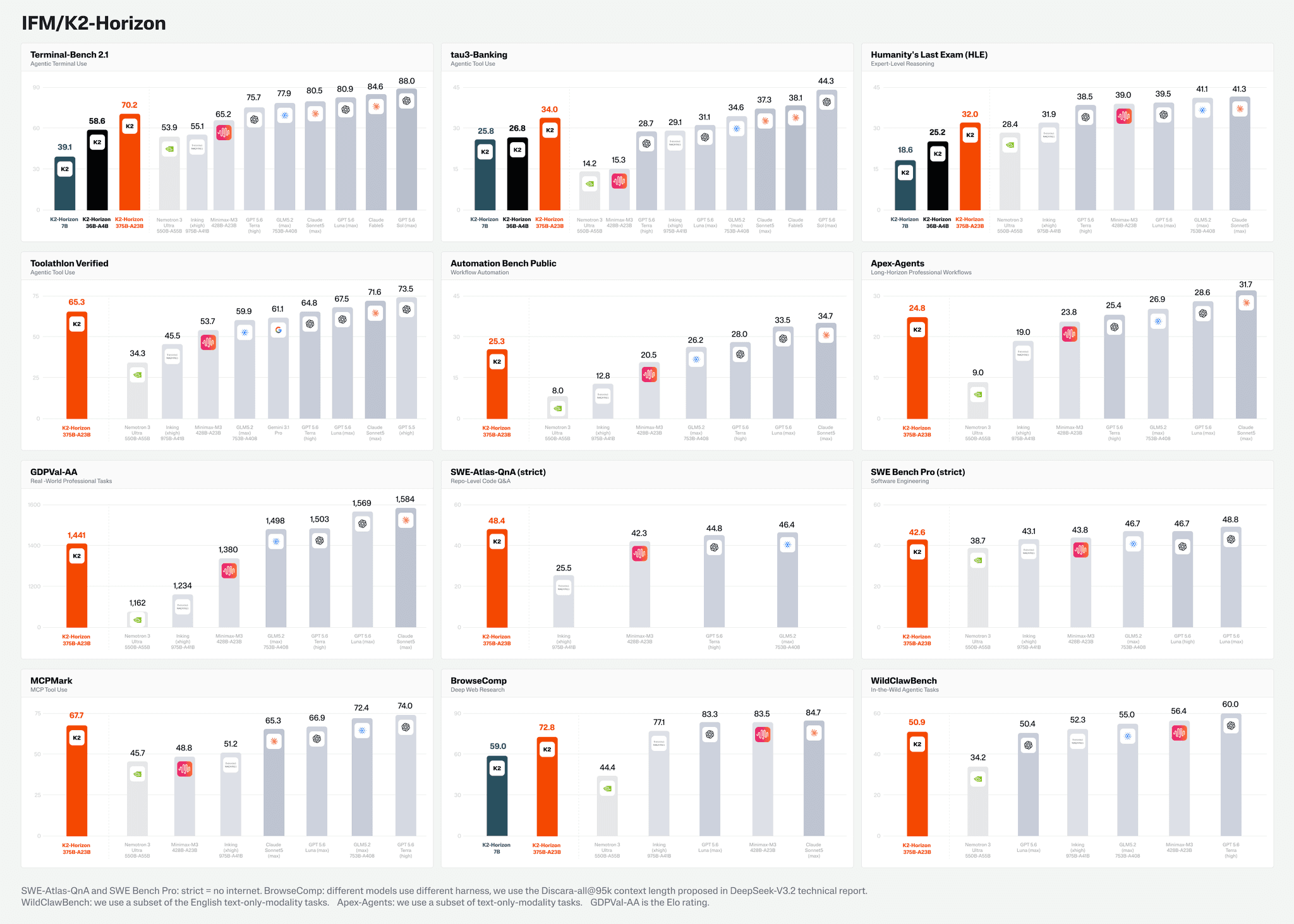
The performance metrics for K2 Horizon are nothing short of staggering. In the small-scale category, the 0.9B, 3.7B, and 7B models have officially set new State-of-the-Art (SOTA) benchmarks for their respective parameter counts. This means that a 7B K2 Horizon model can outperform many legacy 13B or even 30B models from previous generations in critical reasoning tasks.