Model Releases
Breaking the Coding Agent Barrier: KAT-Coder-V2.5-Dev is Here
Kwaipilot releases KAT-Coder-V2.5-Dev, an open-weight MoE model that shatters SWE-bench records and redefines autonomous coding agents.
July 24, 2026
Model ReleaseKAT-Coder-V2.5-Dev
The New Era of Autonomous Coding
The landscape of AI-assisted development just shifted. On July 24, 2026, Kwaipilot officially released KAT-Coder-V2.5-Dev, a model specifically engineered to move beyond simple code completion and into the realm of true autonomous software engineering. For developers tired of models that hallucinate syntax or fail to understand complex repository structures, this release marks a significant milestone in agentic workflows.
This isn't just another fine-tuned LLM; it is a specialized powerhouse designed to act as a collaborator that can reason through entire codebases. By making the model open-weight, Kwaipilot is empowering the global developer community to build local, private, and highly efficient coding agents that rival proprietary closed-source giants.
- Released: July 24, 2026
- License: Apache 2.0 (Open-Weight)
- Primary Focus: Autonomous Coding Agents & Software Engineering
Architecture: Efficiency Meets Intelligence
At the heart of KAT-Coder-V2.5-Dev lies a sophisticated Mixture-of-Experts (MoE) architecture. Built upon the robust Qwen3.6-35B-A3B foundation, the model utilizes a total of 35 billion parameters. However, thanks to the MoE design, only 3 billion parameters are active during any single inference pass. This allows for the intelligence of a much larger model with the latency and computational efficiency of a much smaller one.
The model's performance is driven by the proven KAT-V2.5 recipe. This involves a rigorous post-training pipeline that includes advanced data construction, a specialized Supervised Fine-Tuning (SFT) stage, and a Reinforcement Learning (RL) optimization strategy. This holistic approach ensures that the model doesn't just 'know' code, but understands the logic and intent behind complex software architecture.
- Base Model: Qwen3.6-35B-A3B
- Architecture: Mixture-of-Experts (MoE)
- Total Parameters: 35B
- Active Parameters: 3B
- Training Pipeline: KAT-V2.5 (SFT/RL/Data Optimization)
Benchmark Dominance: The Numbers Don't Lie
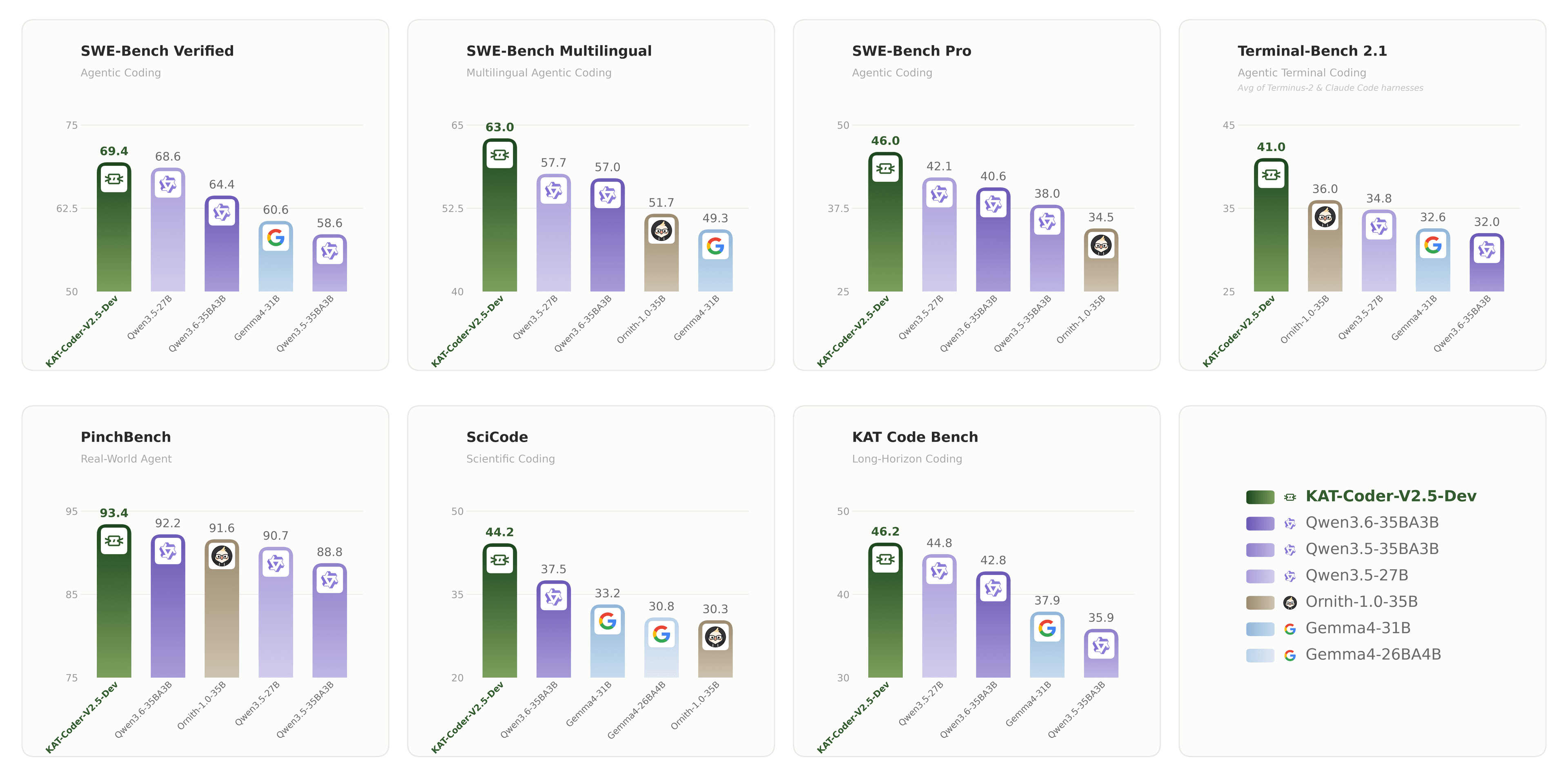
When it comes to evaluating coding agents, standard benchmarks often fail to capture the complexity of real-world engineering. KAT-Coder-V2.5-Dev, however, excels in the most demanding environments. It shows unprecedented strength in the SWE-bench suite, which tests a model's ability to resolve real GitHub issues autonomously.
The model's performance across various specialized benchmarks sets a new industry standard. Whether it is navigating multilingual repositories or executing commands in a terminal environment, KAT-Coder-V2.5-Dev demonstrates a level of precision that was previously thought to be the exclusive domain of much larger, dense models.