Model Releases
Tiny Model, Massive Impact: Liquid AI Unveils LFM2.5-230M for Edge Intelligence
Liquid AI's new 230M parameter LFM2.5-230M is redefining on-device AI, delivering high-speed agentic performance on everything from smartphones to robotics.
June 25, 2026
Model ReleaseLFM2.5-230M
Introduction: The Dawn of Truly Local Agentic AI
The era of massive, cloud-dependent LLMs is meeting its most significant challenger: the hyper-efficient edge model. On June 25, 2026, Liquid AI released LFM2.5-230M, a groundbreaking small language model (SLM) designed to bring sophisticated intelligence directly to the hardware it controls.
Unlike previous generations of small models that struggled with complex reasoning, LFM2.5-230M is purpose-built for agentic workflows. It isn't just a chatbot; it is a lightweight reasoning engine capable of running on CPUs, NPUs, and GPUs, making it the ideal candidate for the next wave of autonomous devices, from smartphones to industrial robots.
- Released: June 25, 2026
- Architecture: LFM2 Liquid Foundation Model
- Primary Goal: High-speed, on-device agentic tasks
Key Features & Architecture
At the heart of LFM2.5-230M is the advanced LFM2 architecture, optimized for extreme efficiency without sacrificing the depth of understanding. Despite its diminutive 230M parameter count, the model is a powerhouse of information density, having been pre-trained on a massive 19 trillion tokens.
To ensure high-quality performance at this scale, Liquid AI utilized a sophisticated post-training regime involving distillation from the larger LFM2.5-350M model. This allows the 230M variant to inherit complex reasoning patterns and instruction-following capabilities that typically require much larger parameter counts.
- Parameters: 230M
- Training Data: 19T tokens
- Context Window: 32K token extension
- Training Method: Distillation from LFM2.5-350M
Performance & Benchmarks: Defying the Scaling Laws
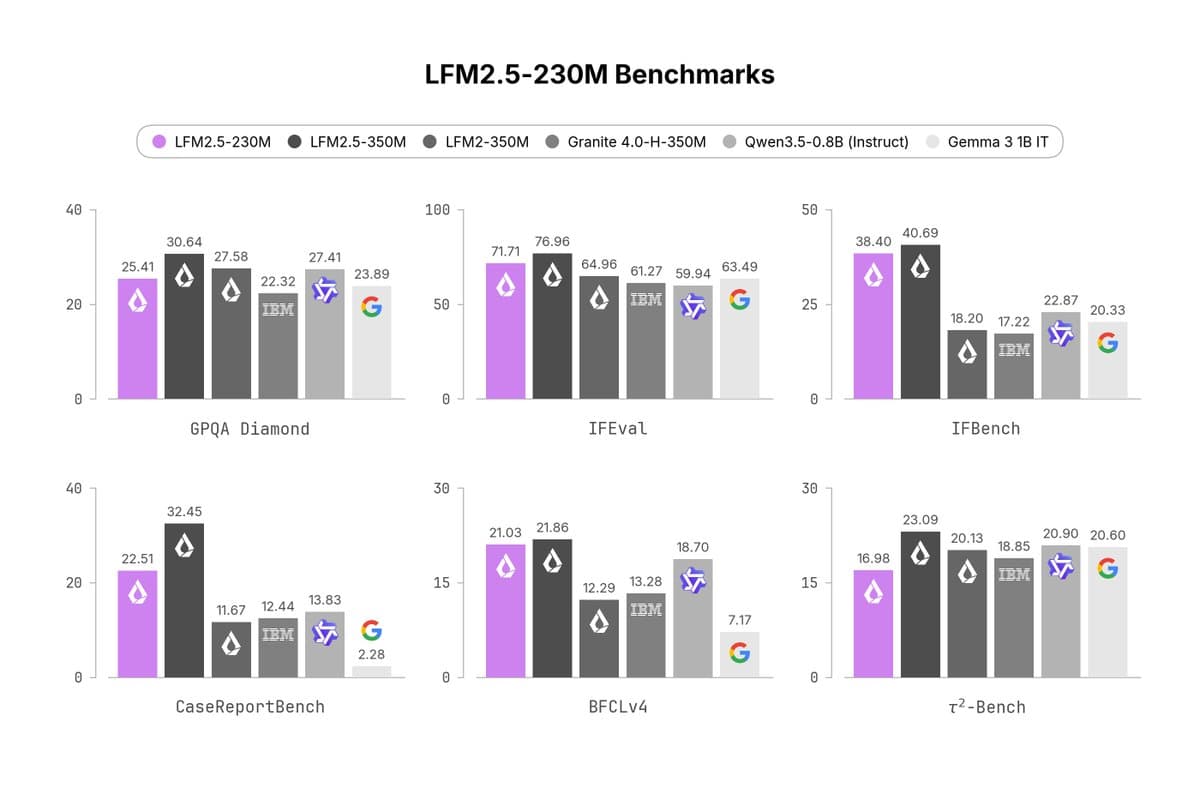
The most striking aspect of LFM2.5-230M is how it punches above its weight class. In rigorous testing, it consistently competes with—and often outperforms—models that are more than twice its size in critical areas such as instruction following, data extraction, and tool use.
On hardware-constrained devices, the throughput is nothing short of revolutionary. On a Samsung Galaxy S25 Ultra (utilizing the Snapdragon Gen4), the model achieves a staggering 213 tokens per second (tok/s) on the CPU. Even on a low-power Raspberry Pi 5, it maintains a usable 42 tok/s, delivering the highest prefill and decode throughput in its class while maintaining the smallest memory footprint.