Model Releases
InclusionAI Releases LingSante-3.1-flash Open-Weight Healthcare MoE Model
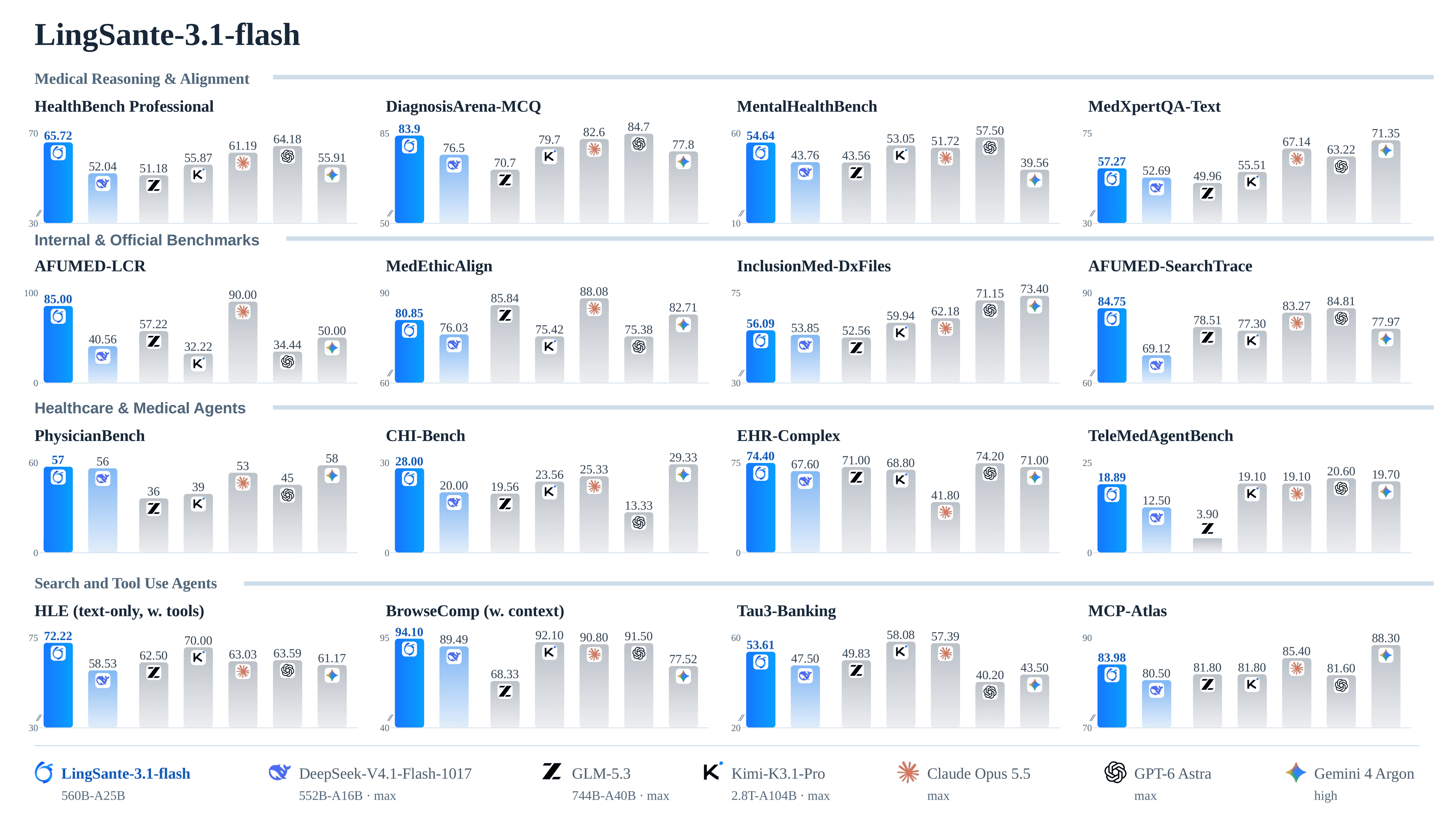
InclusionAI's new LingSante-3.1-flash sets a new benchmark for open-weight medical AI, outperforming GPT-6 Astra on HealthBench Professional.
November 22, 2026
Model ReleaseLingSante-3.1-flash
A Milestone in Open-Source Medical Intelligence
On November 22, 2026, Ant Ling (@AntLingAGI) announced a massive leap forward for specialized AI with the release of LingSante-3.1-flash. Developed under the Ant Group AGI initiative, InclusionAI, this model represents a historic shift in the open-weight landscape, proving that domain-specific expertise can rival—and even surpass—the most powerful closed-source frontier models.
Released under the MIT license on Hugging Face and ModelScope, LingSante-3.1-flash is not just another incremental update. It is a highly specialized Mixture-of-Experts (MoE) model engineered specifically for the complexities of healthcare. By providing high-performance weights to the research community, InclusionAI is democratizing access to state-of-the-art medical reasoning, moving the needle from general-purpose LLMs to specialized clinical intelligence.
- Provider: InclusionAI (Ant Group AGI initiative)
- License: MIT (Open-weight)
- Primary Domain: Healthcare and Medical Reasoning
- Release Date: November 22, 2026
Architectural Deep Dive: Hybrid-Linear MoE
LingSante-3.1-flash is built upon the Ling-3.1-flash foundation, representing a massive scaling effort from its predecessor, Ling-3.0-flash-Sante (which featured 124B total parameters). The new architecture utilizes a sophisticated hybrid-linear Mixture-of-Experts design to balance massive capacity with inference efficiency.
The model boasts a total of 560B parameters, yet it is highly optimized for throughput, activating only 25B parameters per token. The architecture employs 512 routed experts, with 8 active per token, and a unique configuration of 63 KDA and 9 Gated MLA layers (a 7:1 ratio). This allows the model to maintain a massive 1M-token context window while managing a hidden size of 4096 and an expansive 157,184-token vocabulary.
- Total Parameters: 560B
- Activated Parameters: 25B per token
- Context Window: 1M tokens
- Expert Configuration: 512 total, 8 active per token
- Architecture: Hybrid-linear MoE with 63 KDA and 9 Gated MLA layers
Training Methodology and Reasoning Capabilities
Achieving this level of specialized intelligence required a multi-stage training pipeline. InclusionAI utilized a combination of medical-mixed pretraining, mid-training, and supervised fine-tuning (SFT). Crucially, the model underwent task-specific reinforcement learning and multi-teacher on-policy distillation.