Model Releases
The Dawn of Mixture-of-LoRA: Why Macaron-V1-Preview-749B Changes Everything
MindLab Research has released Macaron-V1-Preview-749B, a massive 749B parameter Mixture-of-LoRA model that redefines agentic workflows through specialist adapters.
June 7, 2026
Model ReleaseMacaron-V1-Preview-749B
Introduction: A New Paradigm in Open-Source Intelligence
On June 7, 2026, the landscape of open-source artificial intelligence shifted fundamentally. MindLab Research officially released Macaron-V1-Preview-749B, a model that doesn't just compete with closed-source giants but introduces an entirely new architectural philosophy: Mixture-of-LoRA (MoL).
While the industry has long been obsessed with scaling dense parameters, Macaron takes a more surgical approach. By combining a massive 744B frozen base with specialized, high-performance LoRA adapters, MindLab has created a model that is both incredibly deep in knowledge and hyper-specialized in execution. This isn't just another LLM release; it is a milestone in the evolution of autonomous agentic systems.
- Release Date: June 7, 2026
- Architecture: 749B Mixture-of-LoRA (MoL)
- License: MIT Open Source
- Primary Goal: Production-grade Agentic Intelligence
Architecture: The Power of Mixture-of-LoRA (MoL)
At the heart of Macaron-V1-Preview-749B is a 744B parameter frozen base derived from GLM-5.1. Rather than attempting to force a single set of weights to master everything from creative writing to low-level kernel debugging, MindLab utilizes five distinct 1B-parameter LoRA adapters. This 'MoL' approach allows the model to maintain a massive general knowledge base while switching specialized 'brains' on demand.
The routing mechanism is a masterpiece of engineering. Unlike traditional MoE where routing is hidden in the attention layers, Macaron uses a Router Tool design. This exposes model selection as a standard tool call via an explicit `change_model` function. For developers, this means the model's 'mode' is fully debuggable, observable, and compatible with standard vLLM OpenAI server modes. This architecture is tightly coupled with the Harness Context Protocol (HCP), ensuring that memory, state, and tool-call tokenization remain consistent across all specialist transitions.
- Base Model: 744B GLM-5.1 (Frozen)
- Specialist LoRAs: L0 (General), L1 (Personal), L2 (Coding), L3 (Generative UI), L4 (OpenClaw Agents)
- Context Window: 202,252 tokens
- Precision: bfloat16
- Routing: Explicit `change_model` tool-call mechanism
Performance: Beyond Standard Benchmarks
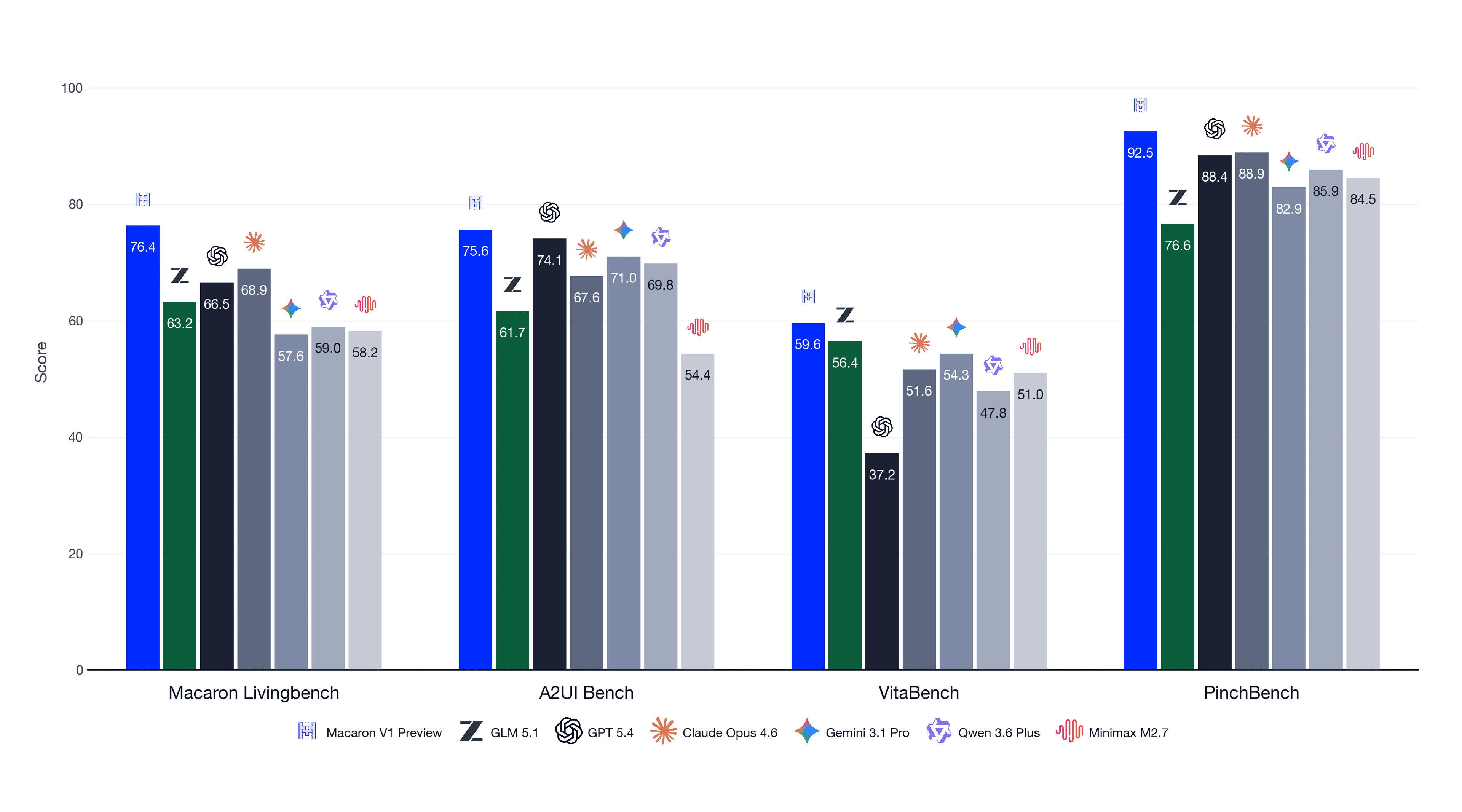
To validate this complex architecture, MindLab introduced the Macaron LivingBench. Traditional benchmarks often fail to capture the nuances of agentic behavior in dynamic environments. LivingBench utilizes coupled dynamic noise, dynamic environments, and dynamic user simulation to test how well the model handles the unpredictability of real-world tasks.