Model Releases
Meta Shatters the Open-Source Ceiling with Muse Glimmer: The New Standard for Agentic AI
Meta Superintelligence Labs releases Muse Glimmer, a 30B multimodal powerhouse designed specifically for autonomous agents and local deployment.
August 10, 2026
Model ReleaseMuse Glimmer
The Dawn of the Agentic Era: Meta's Muse Glimmer
On August 10, 2026, the landscape of open-source artificial intelligence shifted fundamentally. Meta Superintelligence Labs officially released Muse Glimmer, a milestone model that signals a departure from general-purpose chat towards purpose-built agentic intelligence. By opening the weights under the Apache 2.0 license, Meta has effectively democratized high-tier reasoning and multimodal capabilities that were previously locked behind proprietary APIs.
- Released: 2026-08-10 by Meta Superintelligence Labs
- License: Apache 2.0 (Fully Open Source)
- Core Focus: Autonomous agents, multi-step planning, and local efficiency
Architecture: A Dense Multimodal Powerhouse
Unlike the Mixture-of-Experts (MoE) trend that dominated 2024 and 2025, Muse Glimmer utilizes a dense 30B parameter architecture (approximately 29.6B parameters). This design choice ensures high parameter utilization and consistent performance across complex reasoning tasks. The model is natively multimodal, integrating a dedicated ViT-G/14 vision encoder with roughly 1.8B parameters, allowing it to process visual data with the same fluidity as text.
- Architecture: 30B Dense (Non-MoE)
- Vision Encoder: Dedicated ViT-G/14 (~1.8B params)
- Context Window: 131,072+ tokens
- Reasoning Control: Adjustable levels (Low, Medium, High, X-High)
Performance Benchmarks and Competitive Edge
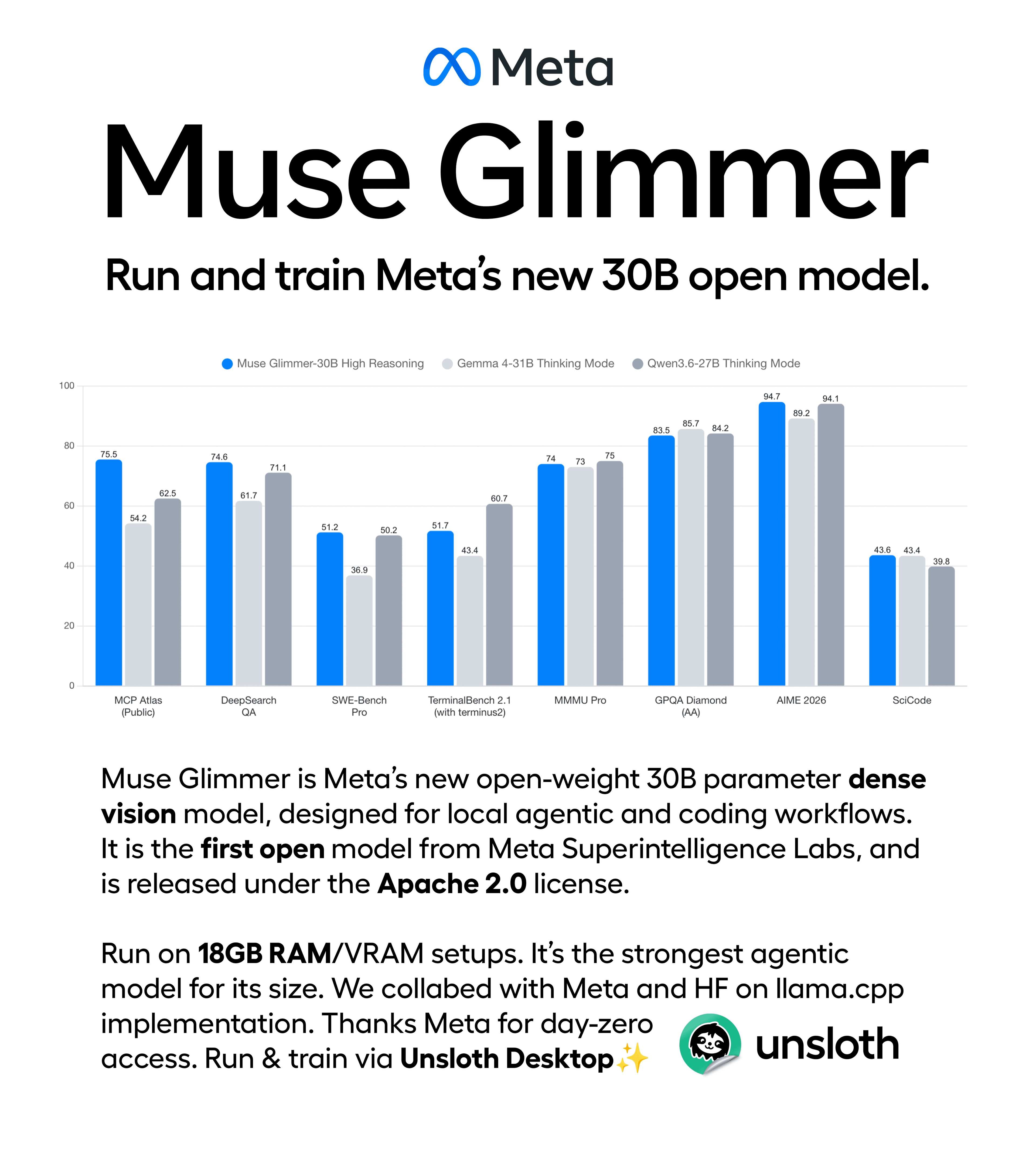
In head-to-head evaluations, Muse Glimmer has established itself as a dominant force in the 30B parameter class. It shows significant performance gains over both Gemma4-31B and Qwen3.6-27B, particularly in tasks requiring long-horizon planning and error recovery. In SWE-bench evaluations, Glimmer's ability to self-correct during coding tasks sets a new benchmark for open-weight models.
- Stronger performance vs Gemma4-31B in reasoning
- Outperforms Qwen3.6-27B in multimodal integration
- Superior SWE-bench scores due to autonomous error recovery mechanisms
Optimized for the Edge: Local Deployment Mastery
One of the most impressive feats of the Muse Glimmer release is its optimization for consumer hardware. While a 30B model would typically require over 55GB of VRAM, Meta's engineers have utilized advanced quantization and speculative decoding techniques to make it highly accessible. Using 4-bit quantization, the model footprint drops to under 20GB, making it perfectly suited for 24GB or 32GB consumer GPUs like the RTX series or Apple Silicon Macs.