Model Releases
The Dawn of Personal Superintelligence: Meta Unveils Muse Spark 1.1
Meta's Muse Spark 1.1 marks a historic shift in multimodal reasoning, offering agentic capabilities and massive context at a fraction of the cost of rivals.
July 9, 2026
Model ReleaseMuse Spark 1.1
Introduction: A Milestone in the AI Arms Race
On July 9, 2026, Meta Superintelligence Labs officially moved the needle on the path toward AGI with the release of Muse Spark 1.1. This isn't just another iterative update; it is a fundamental leap in how multimodal models interact with the digital world. By bridging the gap between raw perception and complex reasoning, Muse Spark 1.1 positions Meta as a primary architect of the 'personal superintelligence' era.
For developers, this release represents a shift from passive chatbots to active, agentic collaborators. Muse Spark 1.1 is built specifically for tasks that require high-level orchestration, computer use, and deep reasoning across diverse media types. It arrives alongside the new Meta Model API, signaling Meta's aggressive intent to dominate the developer ecosystem by offering high-performance reasoning at a disruptive price point.
- Released by Meta Superintelligence Labs on 2026-07-09
- Designed for agentic workflows and multi-agent orchestration
- Part of Meta's vision for personal superintelligence
Key Features & Multimodal Architecture
Muse Spark 1.1 is a powerhouse of multimodal understanding. Unlike models that rely on separate encoders for different modalities, Muse Spark 1.1 is natively built to process text, images, video, audio, and PDF documents simultaneously. This allows for a holistic understanding of context, such as analyzing a video clip while referencing a technical PDF manual provided in the same prompt.
The model's architecture is optimized for long-context reasoning, featuring a massive 1M-token context window. This enables developers to feed entire codebases, long-form video archives, or massive documentation sets into a single session. Furthermore, the model excels at zero-shot generalization, meaning it can adapt to new tools, Model Context Protocol (MCP) servers, and custom skills without needing fine-tuning.
- 1M-token context window for massive data ingestion
- Native multimodal support: Text, Image, Video, Audio, and PDF
- Advanced tool use and MCP server integration
- Supports structured output and parallel function calling
Performance: Setting New Benchmarks
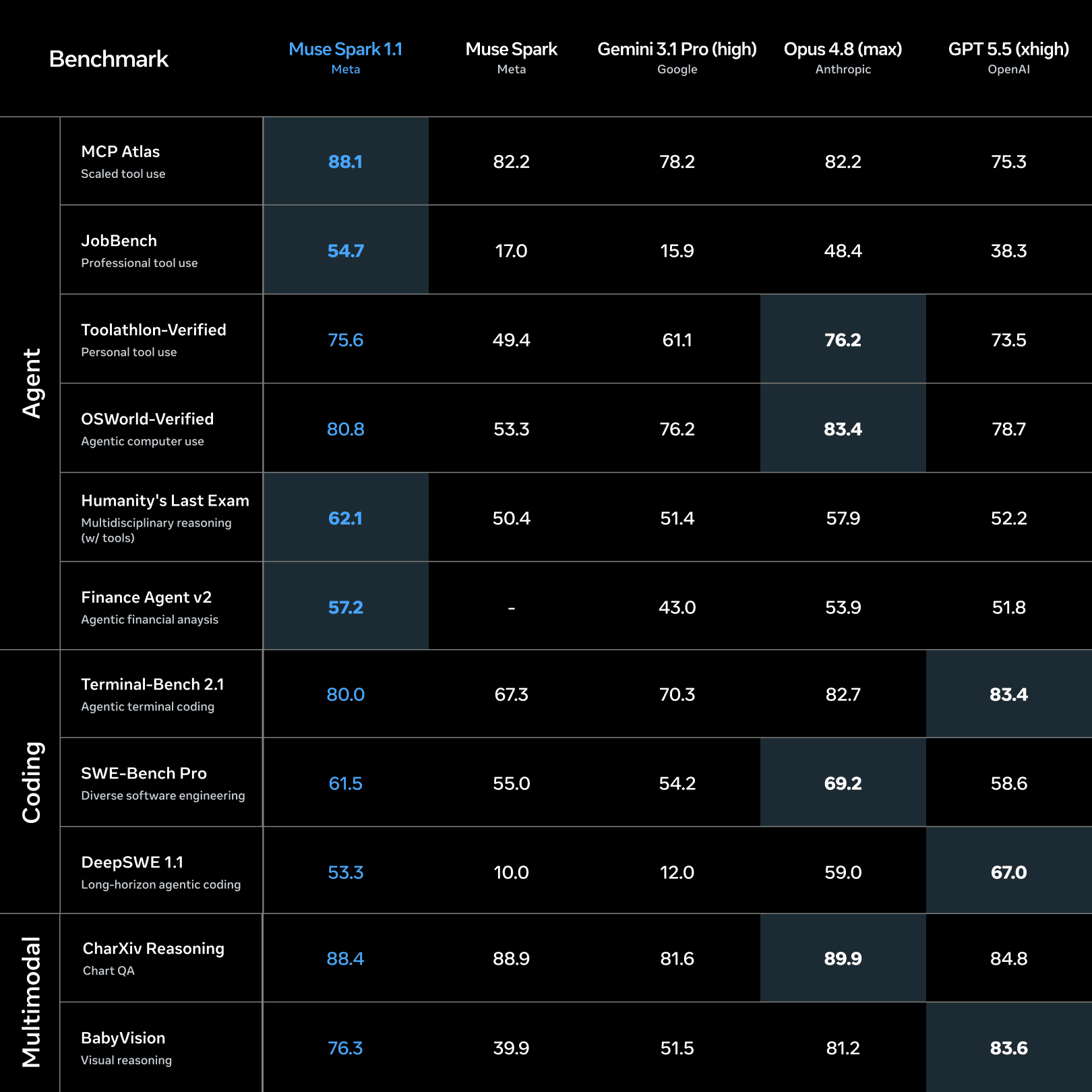
The performance metrics for Muse Spark 1.1 are nothing short of industry-defining. In recent independent testing by Artificial Analysis, the model earned a score of 71 on a rigorous coding benchmark, demonstrating a significant 'step-change' from the original Muse Spark. This performance is particularly notable in real-world scenarios involving large-scale codebase management and visual-to-code generation.