Model Releases
Meta's Muse Spark 1.3: The New Frontier in Agentic Reasoning and Coding
Meta officially launches Muse Spark 1.3, introducing the revolutionary 'Contemplating' mode to tackle long-horizon agentic tasks and advanced coding.
September 2, 2026
Model ReleaseMuse Spark 1.3
Introduction: Meta's Strategic Pivot
On September 2, 2026, Meta officially released Muse Spark 1.3, the third major iteration of the flagship model from Meta Superintelligence Labs. This release marks a significant shift in Meta's AI strategy, moving beyond simple chat interfaces toward high-autonomy agentic workflows. Unlike previous releases that focused on raw scale, Muse Spark 1.3 is engineered specifically to bridge the gap in complex reasoning and long-term task execution.
The release has been notably unconventional. Eschewing the traditional massive blog post filled with colorful benchmark graphs, Meta chose a more direct, high-level communication strategy. Instead, Chief AI Officer Alexandr Wang delivered key technical insights via Bloomberg and Axios, signaling a move toward professional, enterprise-grade deployment rather than mere consumer hype.
- Release Date: September 2, 2026
- Model Series: Muse Spark (v1.3)
- Primary Focus: Agentic workflows and advanced coding
- Provider: Meta Superintelligence Labs
Key Features & Architecture: The Power of 'Contemplating'
The standout architectural innovation in Muse Spark 1.3 is the 'Contemplating' mode. While traditional LLMs process tokens in a linear, single-stream fashion, Contemplating mode orchestrates multiple specialized agents in parallel to verify logic, cross-reference code, and simulate outcomes before delivering a final response. This architecture is designed to compete directly with advanced reasoning modes like Gemini Deep Think and GPT Pro.
This multi-agent orchestration allows the model to maintain high coherence over much longer sequences. By utilizing a sophisticated Mixture-of-Experts (MoE) framework, the model can dynamically route sub-tasks to specialized modules, optimizing both latency and reasoning depth. This makes it particularly effective for tasks that require iterative refinement and self-correction.
- Contemplating Mode: Parallel multi-agent orchestration
- Architecture: Advanced Mixture-of-Experts (MoE)
- Primary Capability: Long-horizon agentic tasks
- Reasoning Style: Iterative self-correction and verification
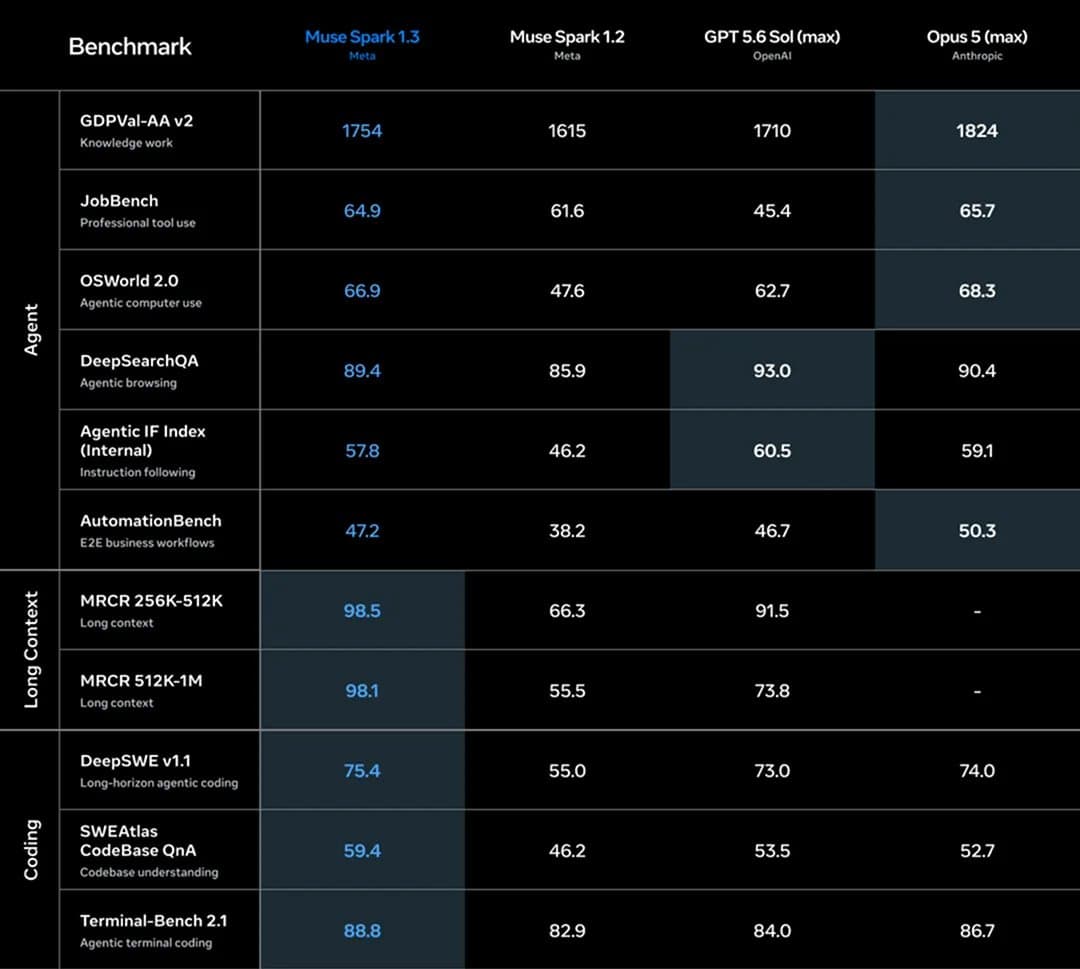
Performance & Benchmarks: Closing the Gap
Meta claims that Muse Spark 1.3 finally closes the performance gap with Anthropic and OpenAI, particularly in the realms of autonomous coding and complex software engineering. While Meta has opted not to release a full technical whitepaper immediately, the industry is awaiting official validation from independent community benchmarks.