Model Releases
Nex-N2.5: The New Open-Source King of Agentic Workflows and Computer Use
Nex AGI has released Nex-N2.5, a powerhouse family of open-weights models designed to bridge the gap between LLMs and autonomous digital agents.
September 8, 2026
Model ReleaseNex-N2.5
Introduction: The Dawn of True Agentic AI
The landscape of open-source artificial intelligence just shifted. On September 8, 2026, Nex AGI officially released Nex-N2.5, a family of models that doesn't just predict the next token, but actually interacts with the world. While the industry has spent years chasing higher MMLU scores, Nex AGI has focused on a much harder problem: agency.
Nex-N2.5 is built from the ground up to function as an agentic system. By combining multimodal perception with advanced reasoning, these models are capable of 'computer use'—the ability to perceive a screen, move a cursor, and execute complex workflows across diverse software environments. This release marks a pivotal moment where open-weights models begin to rival the most sophisticated proprietary systems in practical, real-world utility.
- Released: 2026-09-08
- Provider: Nex AGI
- Category: Open-source agentic models
- Core Focus: Computer use, reasoning, and multimodal autonomy
Architecture: A Scalable Family of Models
Nex-N2.5 is not a single model, but a tiered ecosystem designed to meet different computational needs, from edge deployment to massive-scale reasoning. The family is divided into three distinct architectures: Mini, Pro, and Max.
The Mini and Pro variants are multimodal powerhouses. They are designed to ingest visual data alongside text, allowing them to 'see' user interfaces and provide real-time feedback. In contrast, the Max model utilizes a massive Mixture-of-Experts (MoE) architecture. While Max is text-only, its specialized experts make it a heavyweight in pure logic, coding, and deep reasoning tasks.
- Mini: 35B parameters (Multimodal, optimized for speed/edge)
- Pro: 397B parameters (Multimodal, optimized for complex computer use)
- Max: 1.6T parameters (MoE, text-only, optimized for reasoning/coding)
- License: Open-weights
Performance: Benchmarking the Agentic Frontier
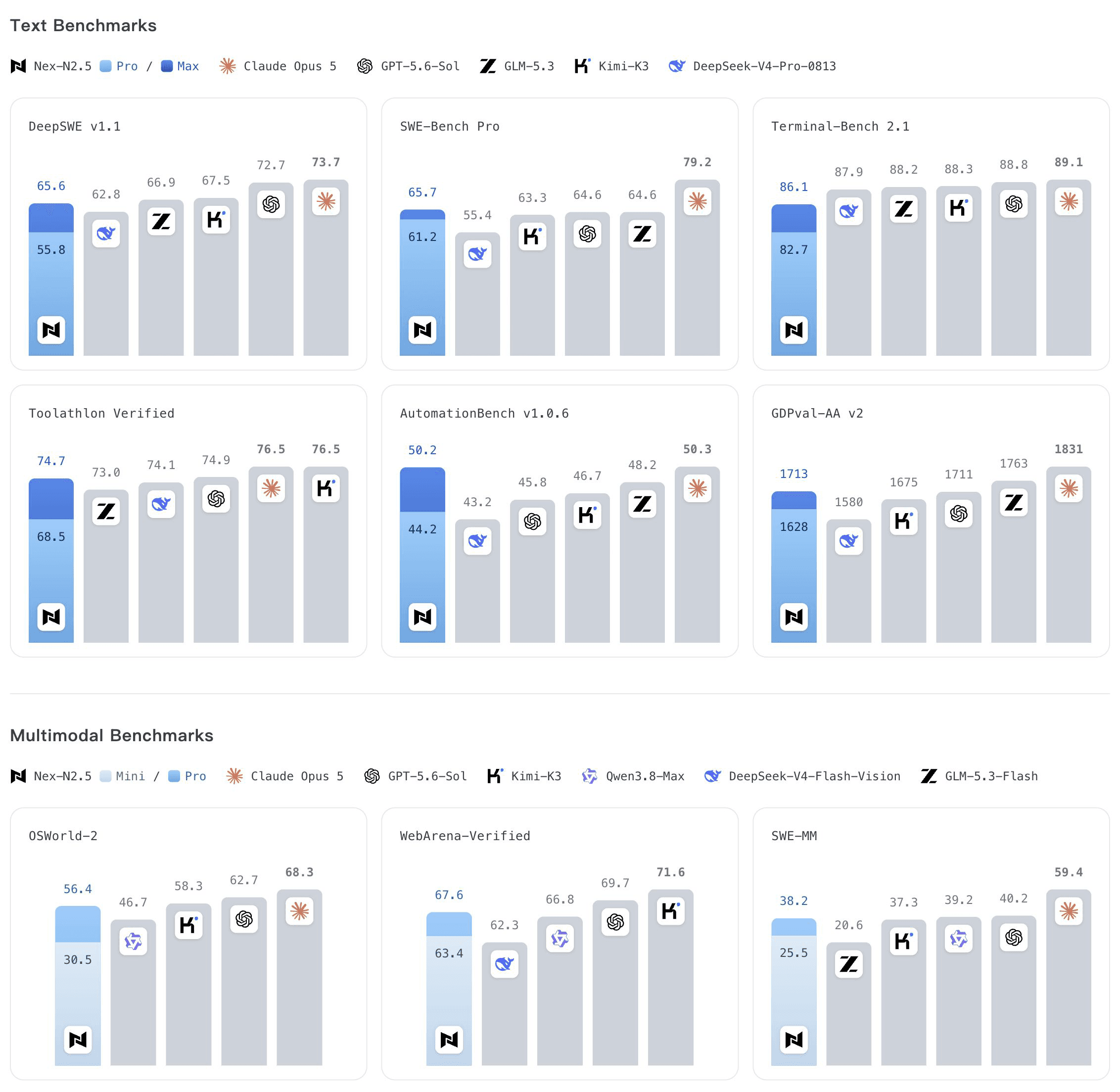
The numbers behind Nex-N2.5 are nothing short of staggering, particularly when looking at agentic benchmarks rather than traditional static datasets. The Pro model has set a new standard for operating system interaction, scoring 56.4 on OSWorld-2, significantly outperforming Qwen3.8-Max, which trailed at 46.7.
The Max model targets the highest tier of reasoning. On the AutomationBench v1.0.6, Nex-N2.5 Max achieved a score of 50.2. To put that in perspective, it sits just 0.1 points behind the industry-leading Claude Opus 5. This parity between an open-weights model and a top-tier proprietary model is a watershed moment for the developer community.