Model Releases
Cohere Unveils North Mini Code: A High-Performance Open-Weights Powerhouse for Developers
Cohere's new North Mini Code model brings elite reasoning and a massive 256K context window to the open-source coding ecosystem.
June 9, 2026
Model ReleaseNorth Mini Code
Introduction
The landscape of open-source coding models just shifted significantly. On June 9, 2026, Cohere officially released North Mini Code, a specialized model designed to bridge the gap between lightweight local assistants and heavy-duty enterprise reasoning engines. For developers who have long felt caught between the convenience of managed APIs and the privacy of self-hosted models, this release offers a compelling middle ground.
This isn't just another fine-tuned LLM; it is a purpose-built tool for the modern software engineering lifecycle. Whether you are performing complex refactors on a massive monorepo or building autonomous agentic pipelines, North Mini Code provides the reasoning depth required to handle sophisticated logic without the massive computational overhead of larger generalist models.
- Released: June 9, 2026
- Provider: Cohere
- License: Apache 2.0 (Open Source)
- Primary Focus: Code generation and reasoning
Key Features & Architecture
North Mini Code is built on a highly efficient architecture that prioritizes both intelligence and throughput. While it is categorized as an open-weights model, its underlying design allows it to punch far above its weight class in terms of reasoning capabilities. It is a text-in, text-out model, optimized specifically for the nuances of programming languages and technical documentation.
One of the most standout features is the massive context window. Supporting up to 256K tokens, the model can ingest entire codebases, long-form technical specifications, or extensive documentation sets in a single prompt. Furthermore, it supports an impressive output capacity of up to 64K tokens, making it capable of generating large-scale boilerplate, entire modules, or comprehensive test suites in one go.
- Context Window: 256K tokens
- Max Output: 64K tokens
- Modality: Text-in, Text-out only
- Architecture: Optimized for high-reasoning efficiency
Performance & Benchmarks
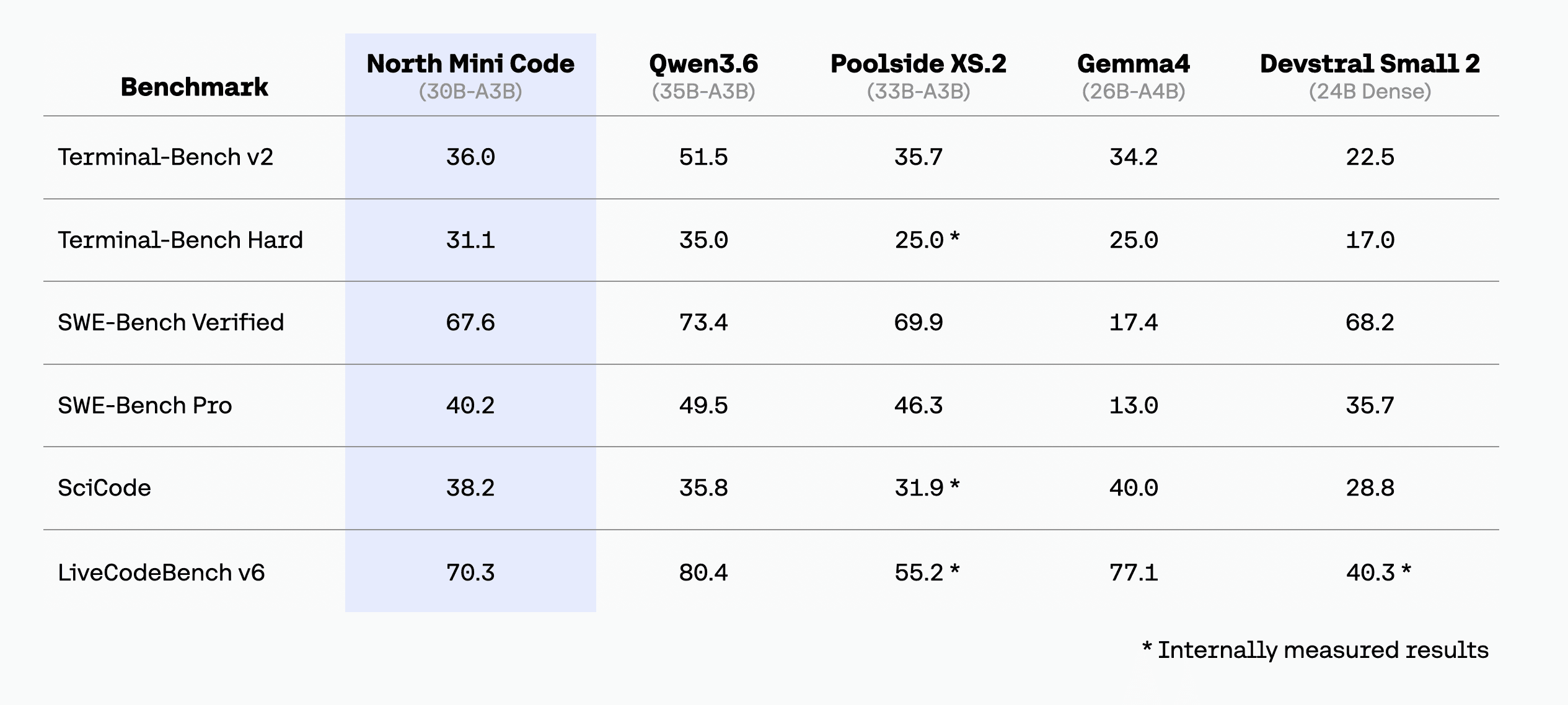
To understand the caliber of North Mini Code, one must look at the benchmarks. The model achieves a remarkable 75.7% on the GPQA Diamond, a benchmark known for testing advanced generalist reasoning. This places North Mini Code in the same tier as many of the world's most advanced proprietary reasoning models, proving that 'mini' does not mean 'limited.'