Model Releases
Beyond Autonomy: Why Qwen3.8-Max is a Paradigm Shift for AI Agents
Alibaba's Qwen3.8-Max arrives with 2.4T parameters and a self-evolving coding harness, redefining what it means for an AI to be truly autonomous.
August 3, 2026
Model ReleaseQwen3.8-Max
Introduction: The Dawn of the Autonomous Era
On August 3, 2026, the AI landscape shifted fundamentally. The Alibaba Qwen Team officially released Qwen3.8-Max, a milestone model that moves beyond simple chat interfaces into the realm of true autonomous agency. This isn't just another incremental update; it is a 2.4-trillion-parameter Mixture-of-Experts (MoE) flagship designed to handle complex, long-horizon tasks that previously required human oversight.
For developers and AI engineers, the significance of Qwen3.8-Max lies in its ability to transition from 'answering questions' to 'executing projects.' Whether it is managing a software repository or navigating complex legal workflows, this model demonstrates a level of reasoning and self-correction that sets a new industry standard for multimodal intelligence.
- Release Date: August 3, 2026
- Architecture: 2.4T Parameter Mixture-of-Experts (MoE)
- Core Focus: Autonomous Agency and Multimodal Reasoning
- Status: Flagship Multimodal Model
Architecture & Multimodal Mastery
At the heart of Qwen3.8-Max is a massive 2.4-trillion-parameter MoE architecture. This design allows the model to maintain extreme specialized knowledge across diverse domains—such as finance, law, and design—while remaining computationally efficient during inference. Unlike dense models, Qwen3.8-Max activates only a fraction of its parameters for any given task, enabling high-speed processing of massive datasets.
The model's multimodal capabilities are natively integrated, not bolted on. This means its visual understanding is deeply intertwined with its reasoning engine. It can perform deep semantic analysis on ultra-long documents and extended video content, following a full cycle of planning, execution, and verification. It doesn't just 'see' an image; it understands the temporal and logical implications of visual data within a workflow.
- 2.4T MoE Parameters for domain-specific expertise
- Native visual understanding for end-to-end execution
- Deep semantic analysis for long-form video and documents
- Closed-loop feedback mechanisms for self-evolution
The 10-Day Developer: Autonomous Coding & Self-Evolution
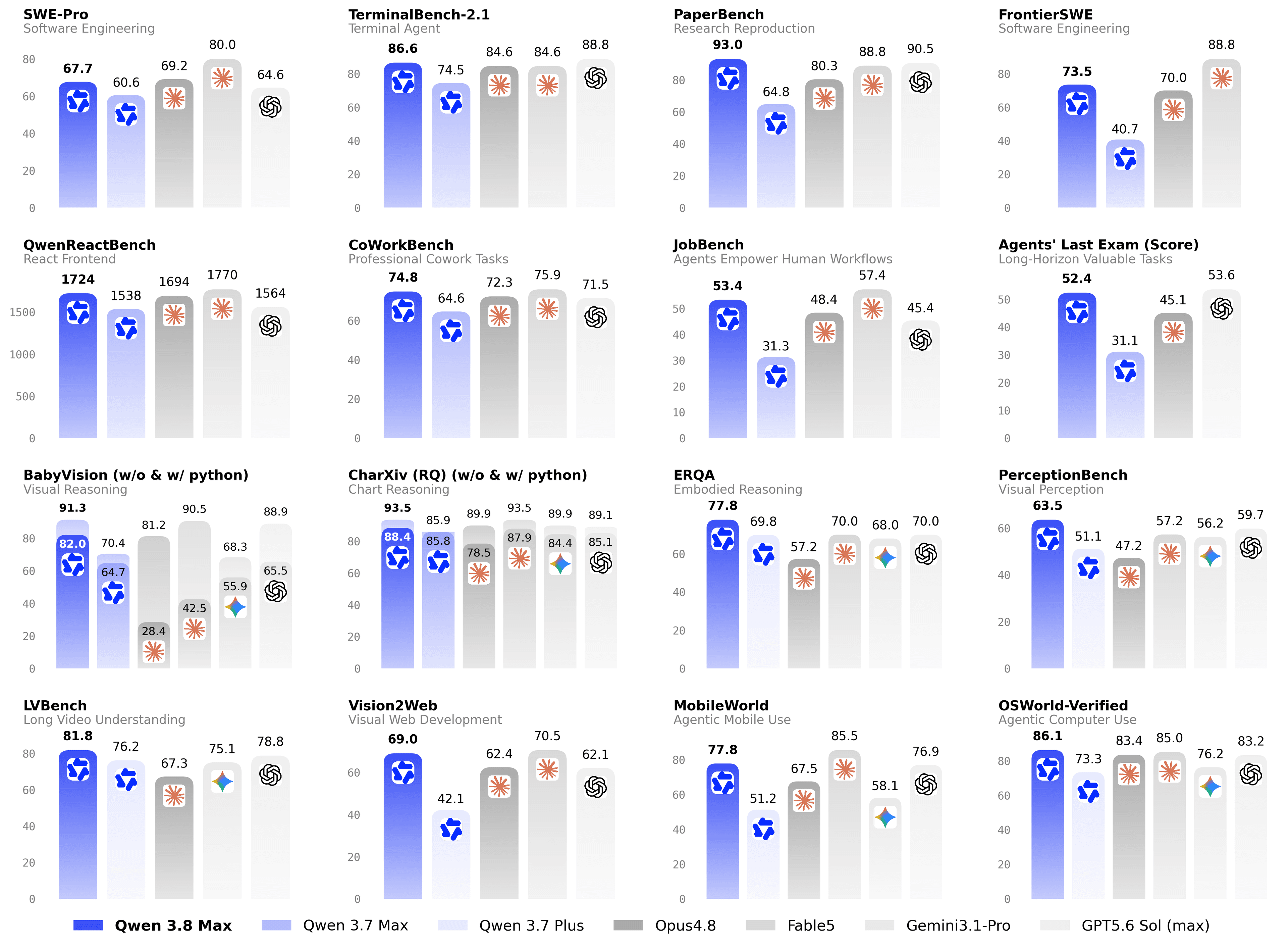
Perhaps the most staggering achievement of Qwen3.8-Max is its performance in software engineering. The model has demonstrated the ability to autonomously code and deliver complete projects spanning over 10 days of human work—starting from an empty folder and ending with a finished, tested product. A prime example is the 'oh-my-cli' project (available at qwen-code-dev-bot/oh-my-cli), where the model built a self-evolving engineering harness from scratch.