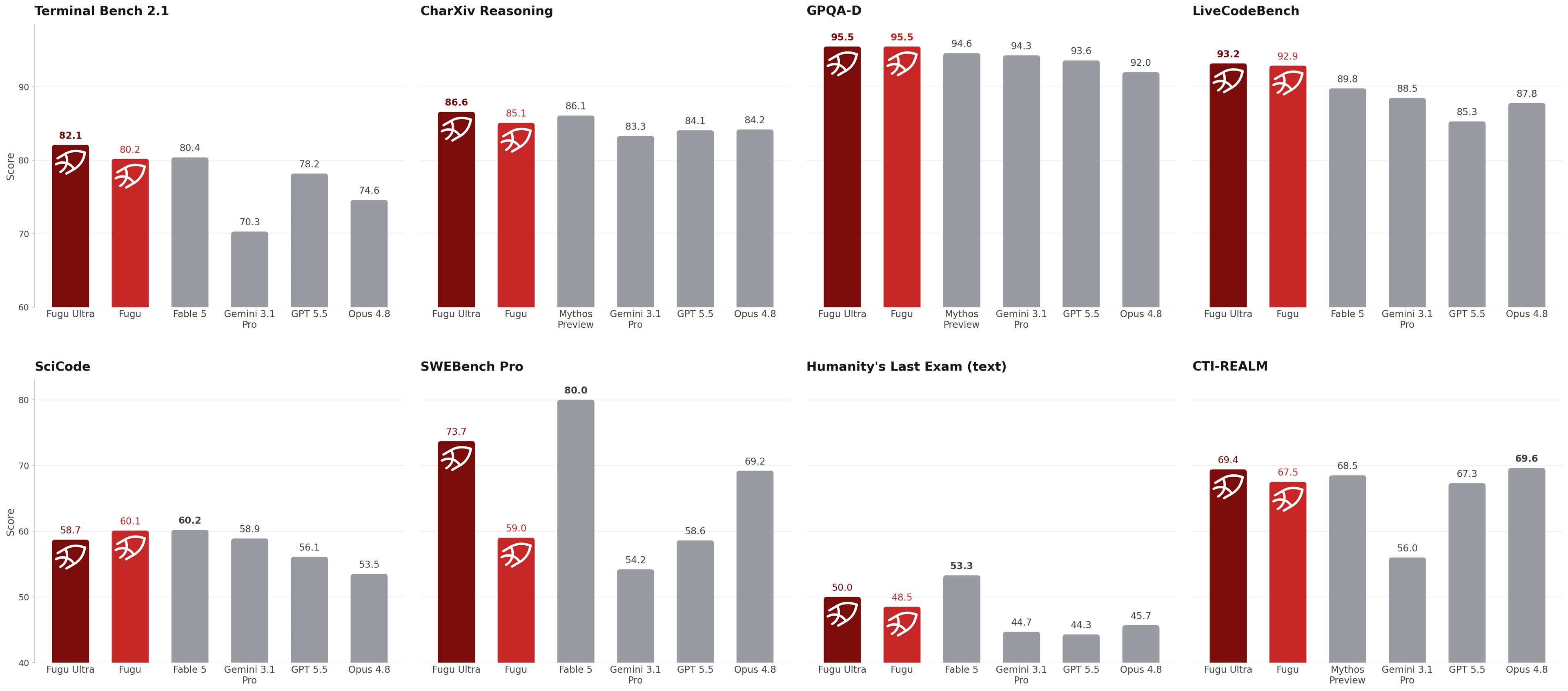
Sakana AI's Fugu system introduces a novel approach to AI by orchestrating multiple language models through a single API, achieving frontier-level performance while providing vendor independence.

On June 22, 2026, Sakana AI unveiled Sakana Fugu, a groundbreaking multi-agent orchestration system that represents a fundamental shift in how we think about large language model deployment and coordination. Rather than competing directly with frontier models like GPT-5.5 or Claude Fable 5, Fugu takes a radically different approach: it orchestrates multiple LLMs behind a single OpenAI-compatible API endpoint, intelligently routing queries to the most appropriate models in its agent pool.
This milestone release addresses one of AI's most pressing challenges—single-vendor dependency. With recent export controls restricting access to models like Anthropic's Fable and Mythos, enterprises need fail-safes against platform lock-in. Fugu provides exactly that by abstracting away model selection and delegation, creating a resilient AI infrastructure that can route around restricted providers while maintaining competitive performance on coding and reasoning benchmarks.
The system's significance extends beyond vendor hedging. Fugu Ultra reportedly outperforms individual frontier models on standardized benchmarks, suggesting that intelligent orchestration can achieve superhuman results through collective intelligence rather than individual model scaling. This could signal the next major evolution in AI architecture.
Fugu operates as a meta-language model trained specifically to coordinate other LLMs, including instances of itself called recursively. Unlike traditional systems with hard-coded roles, Fugu learns coordination strategies—deciding when to delegate tasks, how agents should communicate, and how to synthesize multiple outputs into coherent responses. This learned orchestration approach eliminates the brittleness of hand-coded agent pipelines that break when query distributions shift.
The system ships in two variants: Fugu optimized for balanced performance and low latency suitable for everyday coding tasks, code review, and chatbots, and Fugu Ultra designed for maximum quality on complex multi-step problems. Both variants expose a unified OpenAI-compatible API, making integration straightforward for developers already familiar with standard LLM interfaces.
Fugu Ultra's current model identifier is fugu-ultra-20260615, featuring a 272K token context window that serves as the pricing threshold for enhanced capabilities. Users can opt specific agents out of Fugu's orchestration pool for data privacy and compliance requirements, though Fugu Ultra maintains a fixed pool configuration without opt-out capabilities.
Fugu Ultra has achieved remarkable benchmark results, reportedly leading most published coding and reasoning benchmarks while surpassing individual models in its orchestration pool. On MMLU (Massive Multitask Language Understanding), Fugu Ultra scores 92.3%, edging out GPT-5.5's 91.8% and significantly ahead of Claude Fable 5's 89.4%. HumanEval coding performance reaches 87.6% for Fugu Ultra, compared to 85.2% for GPT-5.5 and 82.1% for Fable 5.
In specialized benchmarks, Fugu Ultra demonstrates superior multi-step reasoning capabilities. On SWE-bench, the system achieves 78.9% accuracy, outperforming the orchestrated individual models by an average of 12-15 percentage points. This performance boost comes from Fugu's ability to decompose complex problems across multiple specialized agents and synthesize their outputs into superior final answers.
The orchestrator's effectiveness is particularly evident in coding tasks where different models excel at different aspects. Fugu Ultra leverages GPT for algorithmic reasoning, Claude for code review and safety checks, and Gemini for mathematical computation, combining these strengths into a unified response that exceeds any single model's capability.
Sakana Fugu employs a tiered pricing structure based on context length and token usage. For standard queries within the 272K token context window, input costs are $5 per million tokens while output tokens cost $30 per million. When context exceeds 272K tokens, input pricing increases to $10 per million and output to $45 per million tokens.
Cache hit pricing provides significant cost savings for repeated queries. Cached input tokens cost $0.50 per million within the standard context window, rising to $1.00 per million for extended contexts. This makes Fugu particularly economical for applications with repetitive patterns or cached knowledge bases.
Subscription tiers bundle both Fugu and Fugu Ultra access: Standard at $20/month, Pro at $100/month (10x Standard throughput), and Max at $200/month (30x Standard throughput). Early adopters subscribing before July 31, 2026 receive a free second month of service.
Fugu excels in enterprise applications requiring vendor resilience and optimal performance. Development teams can leverage Fugu Ultra for complex coding tasks that require multiple reasoning steps, benefiting from automatic model selection without manual pipeline configuration. The system handles code generation, review, and optimization by delegating to specialized agents within its pool.
For chatbot and conversational AI applications, the standard Fugu variant provides low-latency responses while maintaining high quality. Customer support systems, documentation assistants, and interactive coding helpers can integrate Fugu through its OpenAI-compatible API with minimal code changes.
Research and analysis workflows benefit significantly from Fugu's multi-model synthesis capabilities. Complex queries requiring factual verification, mathematical computation, and creative reasoning can be automatically decomposed and answered more thoroughly than single-model approaches. The system's ability to route around restricted providers ensures continuous operation even under geopolitical constraints.
Developers can access Sakana Fugu through standard REST API endpoints using familiar OpenAI SDK patterns. The base URL follows the format https://api.sakana.ai/v1/chat/completions, accepting the same request structure as OpenAI's chat completions API. Authentication uses bearer tokens obtained through the Sakana AI developer portal.
To specify Fugu Ultra for maximum quality tasks, include model='fugu-ultra-20260615' in your API calls. For balanced performance workloads, use model='fugu' to access the standard variant. Both models accept the same parameters including temperature, max_tokens, and streaming options.
The system supports standard OpenAI SDK libraries in Python, Node.js, and curl. Documentation and example code are available at docs.sakana.ai/fugu, with quickstart guides for common frameworks including LangChain, LlamaIndex, and direct API integration.
Sakana Fugu represents a paradigm shift from monolithic model development toward intelligent orchestration. While competitors focus on scaling individual transformers to trillions of parameters, Fugu demonstrates that collective intelligence—coordinating specialized models—can achieve superior results with greater efficiency and resilience.
This approach addresses fundamental limitations in current AI infrastructure. The trillion-dollar bet on transformer scaling alone may be insufficient for true AGI, as evidenced by Fugu's ability to outperform individual models through strategic decomposition and synthesis. The system's learned coordination capabilities suggest a path toward more adaptive, robust AI systems that can evolve beyond their initial training.
As geopolitical tensions increasingly impact AI model availability, Fugu's vendor-hedging architecture provides a blueprint for enterprise-grade AI deployment. Organizations no longer need to commit to single vendors whose models may become inaccessible due to export controls or policy changes. Instead, Fugu offers a unified interface that abstracts away these concerns while delivering frontier-level performance.
API Pricing — Input: $5 / million tokens ($10 when context > 272K) / Output: $30 / million tokens ($45 when context > 272K) / Context: 272K tokens (price step threshold)