StarCoder 2: Revolutionary Open-Source Code Generation Models with 3B, 7B, and 15B Parameters
BigCode and ServiceNow release StarCoder 2, a family of open-source code generation models with 16K context and support for 600+ programming languages.

Introduction
The landscape of code generation just got a major upgrade with the release of StarCoder 2, a groundbreaking family of open-source large language models designed specifically for coding tasks. Developed through the collaborative efforts of BigCode, ServiceNow, Hugging Face, and NVIDIA, StarCoder 2 represents a significant leap forward in accessible, high-performance code AI.
What makes StarCoder 2 particularly compelling for developers is its commitment to open-source principles while delivering enterprise-grade performance. Unlike many proprietary alternatives, these models offer complete transparency in their development and licensing, making them ideal for organizations requiring full control over their AI infrastructure.
The timing couldn't be better as the demand for intelligent code completion, automated refactoring, and AI-assisted development continues to surge across the tech industry. With StarCoder 2, teams can now implement powerful code generation capabilities without the constraints of closed ecosystems or restrictive licensing agreements.
Key Features & Architecture
StarCoder 2 comes in three distinct parameter sizes: 3 billion, 7 billion, and 15 billion parameters, allowing teams to choose the optimal balance between performance and resource requirements. Each variant has been meticulously trained on over 4 trillion tokens from The Stack v2 dataset, ensuring comprehensive coverage of modern programming paradigms and best practices.
One of the standout architectural features is the 16,000-token context window powered by sliding window attention mechanisms. This substantial context allows the models to maintain awareness of extensive codebases during generation tasks, enabling more coherent and contextually appropriate completions across larger files and projects.
The models demonstrate remarkable versatility by supporting over 600 programming languages, far exceeding the approximately 80 languages supported in the original StarCoder release. This expanded language support includes everything from mainstream languages like Python, JavaScript, and Java to specialized domain-specific languages and emerging frameworks.
A critical differentiator is that StarCoder 2 was trained exclusively on permissively licensed code, addressing legal concerns that have plagued other code generation models. This approach ensures that generated code doesn't carry potential copyright baggage, providing peace of mind for commercial applications.
- Available in 3B, 7B, and 15B parameter variants
- 16K context window with sliding window attention
- Trained on 4T+ tokens from The Stack v2
- Supports 600+ programming languages
- Fill-in-the-middle capability for efficient editing
Performance & Benchmarks
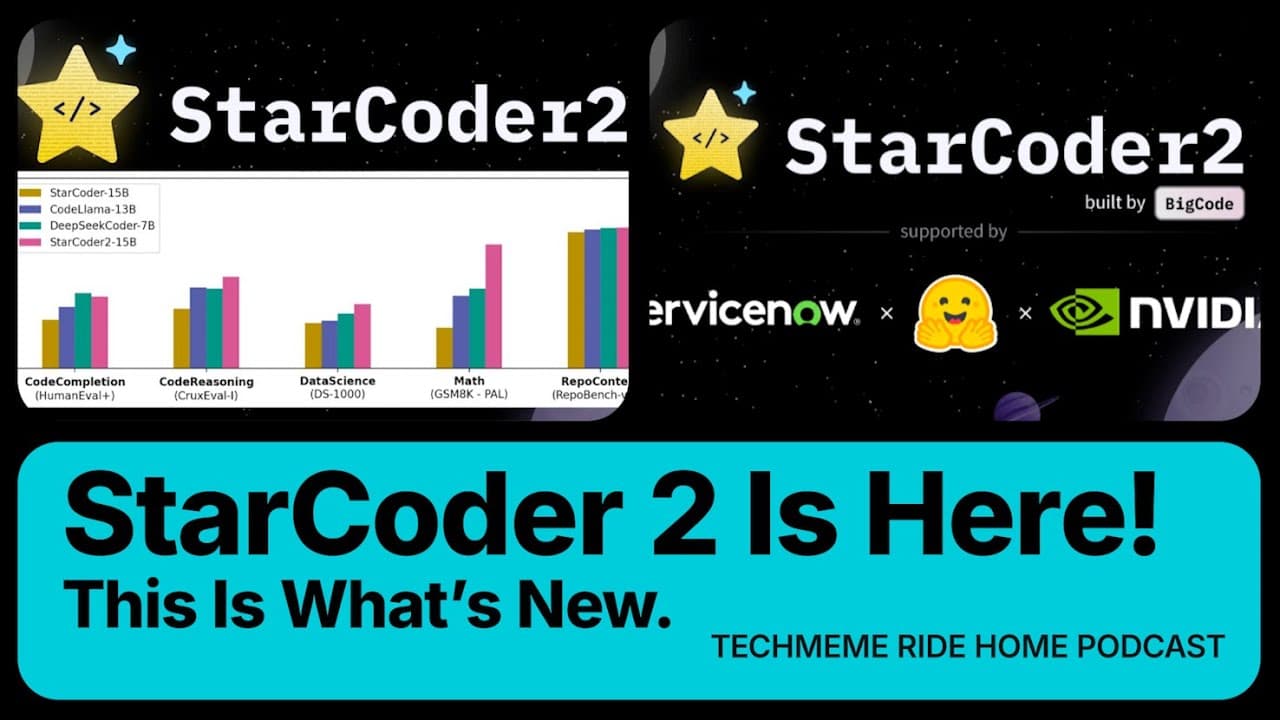
While specific benchmark scores are still being validated across the community, early testing indicates that StarCoder 2 significantly outperforms its predecessor across multiple evaluation metrics. The expanded training corpus and improved architecture contribute to enhanced accuracy in code completion, function generation, and bug detection tasks.
The multi-size approach allows for optimized deployment scenarios, where smaller 3B models can handle basic autocomplete functions with minimal latency, while the 15B variant tackles complex refactoring and generation tasks. Initial assessments suggest the 7B model offers an excellent performance-to-resource ratio for most development environments.
The fill-in-the-middle capability, a feature that allows the model to generate code within existing contexts rather than just completing from a cursor position, demonstrates superior contextual understanding compared to traditional left-to-right generation models. This proves especially valuable for editing existing codebases and implementing targeted functionality.
- Significant improvements over original StarCoder performance
- Enhanced contextual understanding for code editing
- Optimized for various deployment scenarios
API Pricing
As an open-source model, StarCoder 2 doesn't require API fees when self-hosted, making it extremely cost-effective for organizations looking to deploy code generation internally. For cloud-hosted solutions through platforms like Hugging Face Inference API, pricing remains competitive with other code-focused models.
The absence of licensing fees for commercial use, combined with the permissive training data approach, creates a compelling total cost of ownership story. Organizations can scale their AI-assisted development initiatives without worrying about escalating API costs or restrictive usage terms.
- Free for self-hosted deployments
- Competitive pricing on cloud platforms
- No licensing restrictions for commercial use
Comparison Table
When comparing StarCoder 2 to its competitors, several key advantages become apparent. The combination of open-source availability, extensive language support, and large context window places it favorably against both proprietary and open-source alternatives.
Use Cases
StarCoder 2 excels in a variety of development scenarios, from simple code completion to complex refactoring tasks. Its 16K context window makes it particularly well-suited for working with large codebases where maintaining structural awareness is crucial for generating appropriate completions.
The model's fill-in-the-middle capability enables sophisticated editing operations, allowing developers to insert code blocks within existing structures while maintaining syntactic and semantic coherence. This proves invaluable for implementing features, fixing bugs, and updating documentation within established codebases.
Teams building internal development tools, IDE extensions, or code review automation systems will find StarCoder 2's open-source nature and permissive licensing ideal for integration projects. The ability to customize and fine-tune the models for specific organizational needs provides flexibility that proprietary solutions simply cannot match.
- Code completion and suggestion
- Automated refactoring and optimization
- Bug detection and fixing
- Documentation generation
- IDE extension development
- Internal tool creation
Getting Started
Accessing StarCoder 2 is straightforward through multiple channels. The models are available on Hugging Face Hub with pre-trained weights ready for immediate deployment. Developers can leverage the transformers library to integrate the models directly into their applications with minimal setup overhead.
For those preferring managed solutions, various cloud providers and AI platforms are beginning to incorporate StarCoder 2 into their offerings. The open-source nature means that teams can experiment freely, fine-tune models for specific use cases, and deploy without vendor lock-in concerns.
The BigCode community provides extensive documentation and example implementations to help developers get started quickly. Whether you're building a simple code completion plugin or a sophisticated AI-assisted development environment, the resources and community support make implementation achievable for teams of various skill levels.
- Available on Hugging Face Hub
- Compatible with transformers library
- Extensive documentation and examples
- Active community support
Comparison
API Pricing β Input: Free for self-hosted / Output: Free for self-hosted / Context: Open source with no licensing fees