Model Releases
Ornith-1.5-35B-A3B: The Open-Source Milestone That Challenges Claude Opus 4.8
A deep dive into Ornith-1.5's revolutionary self-improving architecture and its massive leap in reasoning and coding benchmarks.
20 августа 2026 г.
Model ReleaseOrnith-1.5-35B-A3B
Introduction: A New Era for Open-Source AI
On August 20, 2026, the landscape of artificial intelligence shifted. The release of Ornith-1.5-35B-A3B by Ornith marks more than just a new model launch; it represents a historical milestone in the democratization of high-tier reasoning capabilities. For years, the gap between closed-source giants and open-source alternatives was widening, but Ornith has effectively bridged it.
The Ornith-1.5 family isn't just a single model, but a cohesive ecosystem designed to scale from edge devices to massive data centers. By releasing weights that rival proprietary models in complex reasoning and agentic workflows, Ornith is setting a new standard for what the developer community can achieve without being locked into a single provider's ecosystem.
- Release Date: August 20, 2026
- Significance: First open-source model to rival Claude Opus 4.8 class performance
- License: MIT License (Unrestricted commercial and research use)
Architecture: The Power of Self-Improving MoE
At the heart of this release is the 35B Mixture-of-Experts (MoE) architecture, specifically the A3B variant. Unlike dense models where every parameter is activated for every token, the A3B configuration utilizes only 3 billion active parameters per forward pass. This allows for the intelligence of a much larger model with the inference efficiency of a significantly smaller one.
What truly sets Ornith-1.5 apart is its training methodology. Moving beyond static datasets, Ornith-1.5 utilizes an end-to-end self-improvement loop. This extends the self-scaffolding strategies introduced in Ornith-1.0, creating a continuous cycle where the model proposes its own tasks, generates task-specific scaffolds, and produces solution rollouts for reinforcement learning.
- Model Family: 9B Dense, 35B MoE (A3B), and 397B MoE
- Active Parameters: 3B (in the 35B variant)
- Training Strategy: End-to-end self-improvement via task-specific scaffolding
- Quantization Support: FP8, GGUF, MLX, and NVFP4
Benchmarks: Shattering the Ceiling
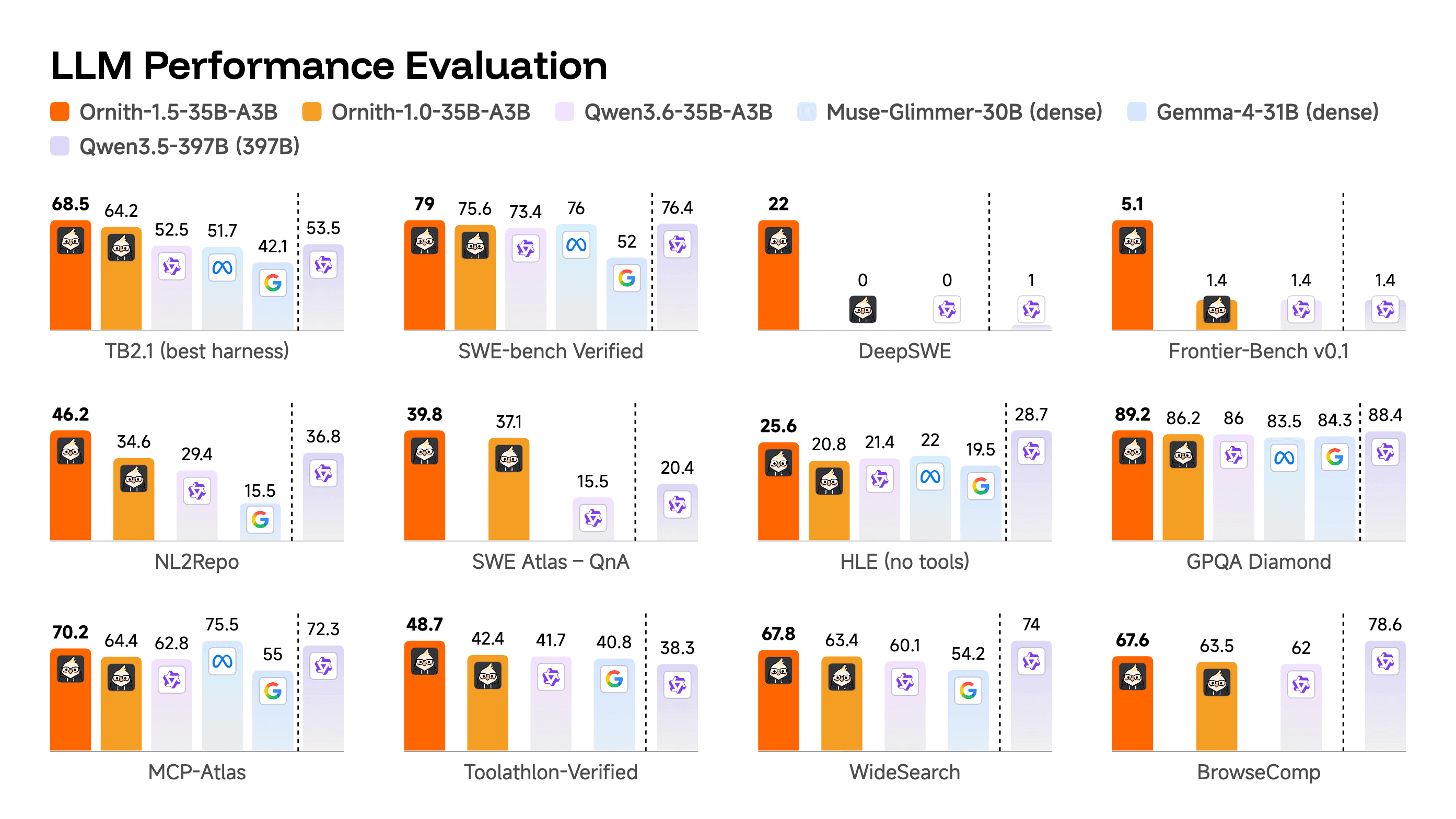
The performance metrics for Ornith-1.5-35B-A3B are nothing short of staggering. In coding-centric benchmarks, the model demonstrates a level of proficiency that was previously reserved for the largest proprietary models. Its ability to navigate complex software engineering tasks is evidenced by its performance on the SWE-Bench.
Beyond code, the model excels in high-level reasoning and tool manipulation. The scores across Terminal-Bench and Tool Decathlon suggest that Ornith-1.5 is not just a chatbot, but a highly capable agent capable of interacting with complex operating system environments and diverse API ecosystems.